Namba
Visited Fri, Nov 20, 2026 · Lunch
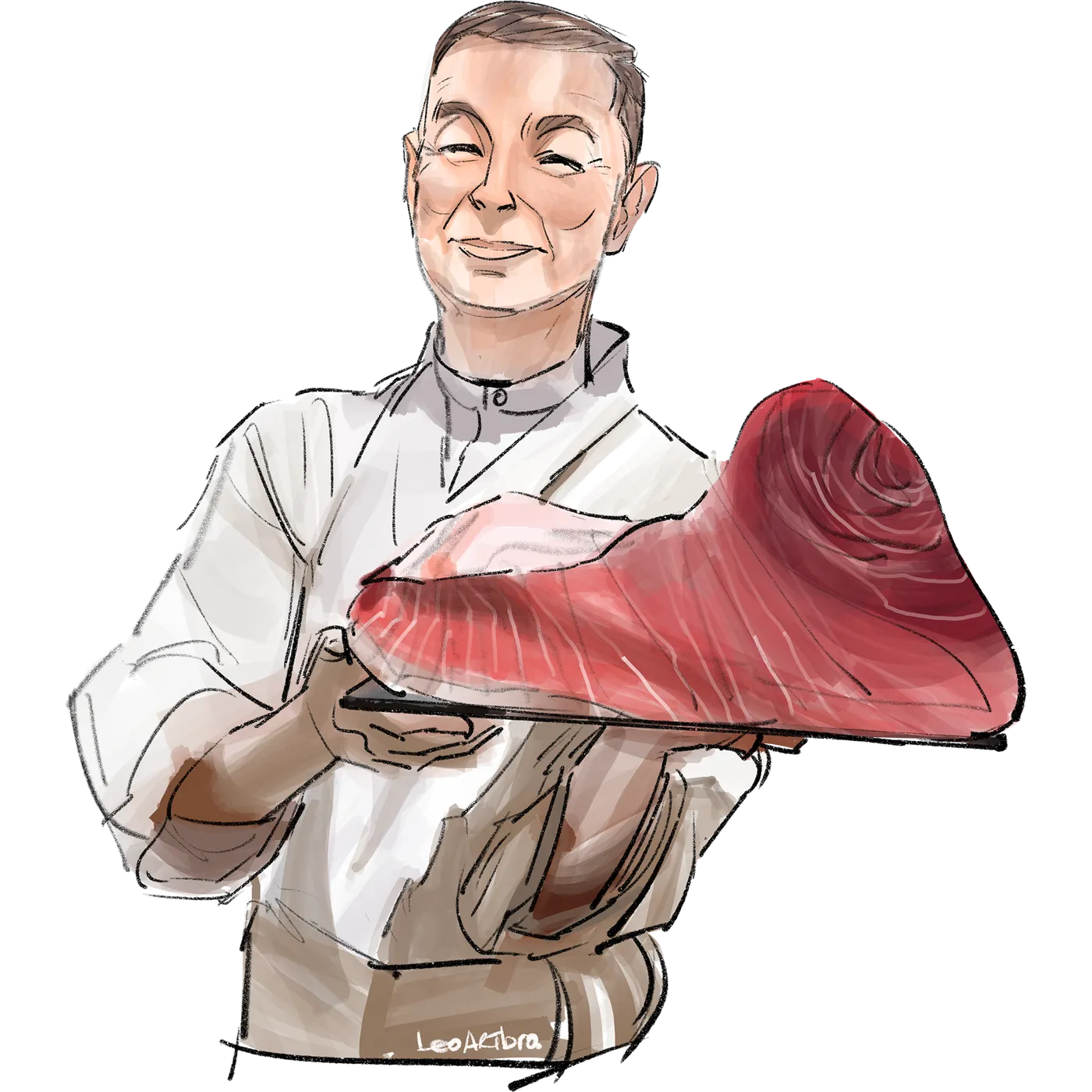
Sushi Namba — 鮨なんば
The Man Who Knows His Tuna
I first visited Sushi Namba in 2017, when I heard about a largely self-taught sushi chef who was making quite a name for himself in Asagaya, a quiet residential neighborhood of Tokyo, far from the famous sushi counters of Ginza. Hidefumi Namba had developed some rather unconventional ideas, particularly about the temperatures of fish and rice, and was questioning things that generations of sushi chefs had taken for granted. That was enough to get me to Asagaya, where I discovered a chef whose cooking I loved. When he moved to Tokyo Midtown Hibiya in 2018, I followed him, and I've been bringing friends to enjoy his sushi ever since.
But this November lunch felt different. In just a few weeks, Namba-san was preparing to open a restaurant in Miami, and I was curious to hear how a man who worries about every tiny detail of his sushi planned to reproduce it on the other side of the world. There was also something I'd been meaning to ask him about his Instagram account, which seems to consist almost entirely of photographs of enormous pieces of raw tuna. Not sushi, mind you. Just tuna, photographed from the side, day after day, with differences that, to my untrained eye, are sometimes practically invisible.
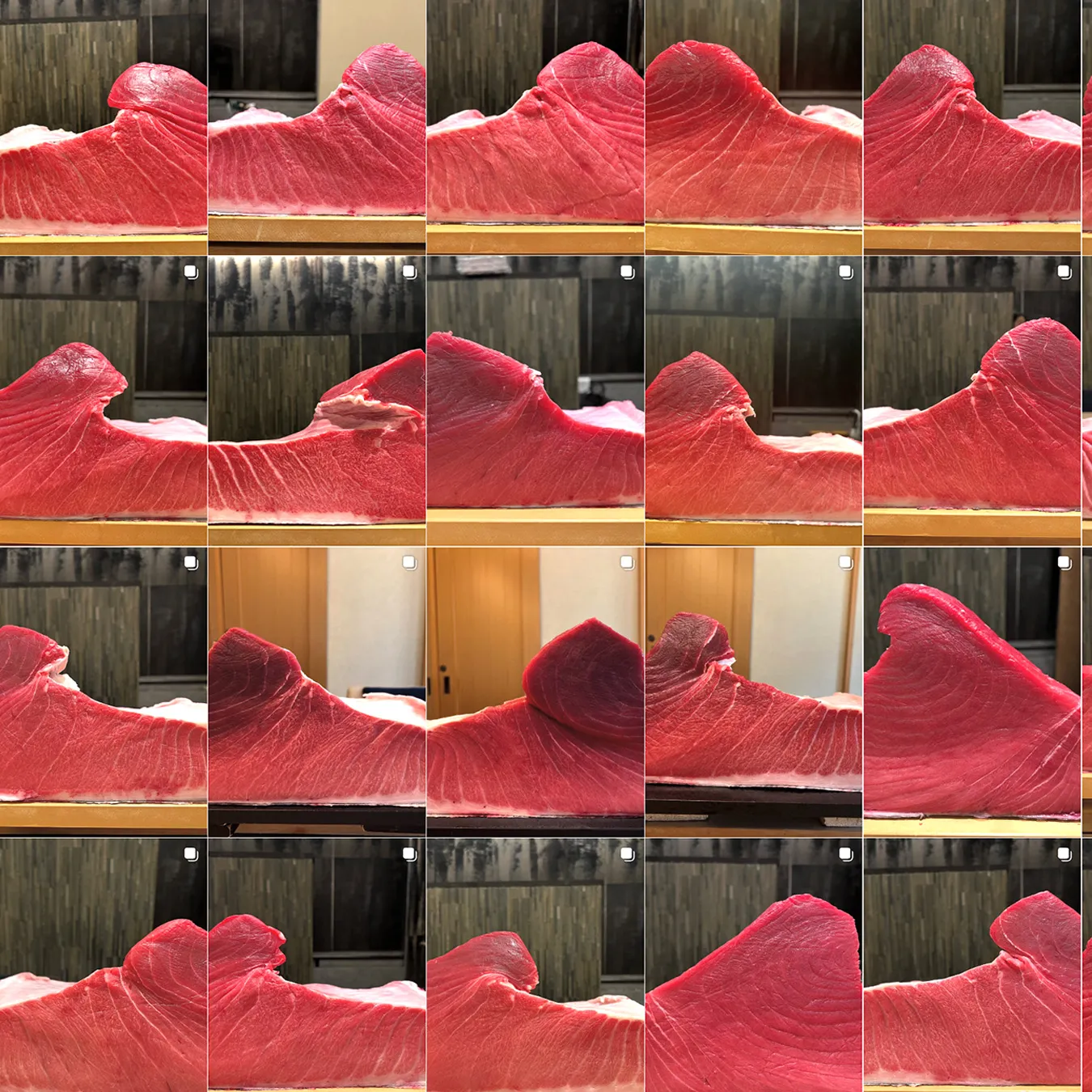
Sea of Tuna — Namba-san's Instagram
Namba-san explained that photographing every tuna he buys has become part of his daily routine. He studies the color, texture, density of the flesh, the way the fat develops, and what happens as the fish ages. Some tuna deteriorates within a week, while others become more delicious. Even two pieces of otoro can be entirely different, he told me. Some have heavy, concentrated fat, while others are so clean and fluid that he compares them to olive oil. I'd never heard anyone describe tuna fat quite that way, and I began to understand why his Instagram account is so entertaining to him, even if the rest of us occasionally struggle to tell one photograph from another.
Of course, Namba-san has good reason to take his tuna seriously. Much of his reputation rests on the quality of the maguro he serves, supplied by Yamayuki, and the man behind it, Yamaguchi-san, whom I like to think of as the King of Tuna.

Yamaguchi-san — The King of Tuna
I couldn't resist asking Namba-san whether Yamaguchi-san might understand him better than most people. His answer made me laugh. Apparently, they maintain what Namba-san considers just the right distance. They don't go out drinking together, and Namba-san suspects that Yamaguchi-san wouldn't find him particularly entertaining company over a few drinks anyway. But when it comes to tuna, he believes they understand each other perfectly. Both want to provide their customers with genuinely delicious maguro, and on that subject, their feelings are exactly the same. I rather like the idea that two men can share such an obsession without necessarily wanting to spend their evenings drinking together.
That afternoon, Namba-san had a magnificent piece of Yamayuki tuna at the counter, with 72.4 kilograms written on its accompanying card. He posed behind it holding several of our Hungry Tourist cards, looking very pleased with the whole arrangement.
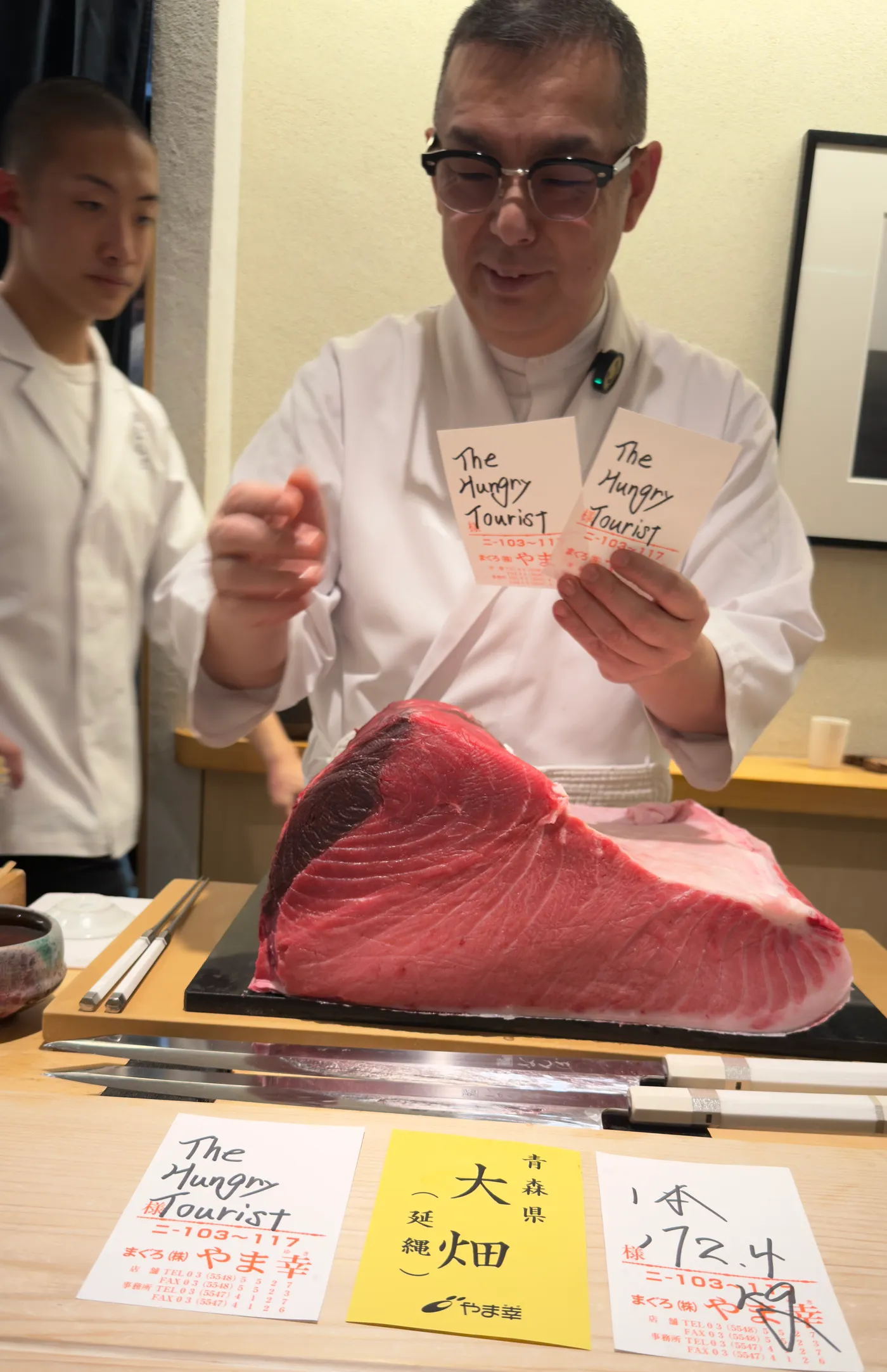
Yamayuki's best
And I was pleased to be back. Nine years after my first visit to Asagaya, I was having another lunch with Namba-san, enjoying his sushi and finally getting the chance to ask him some of the questions I'd been saving up.
What we ate
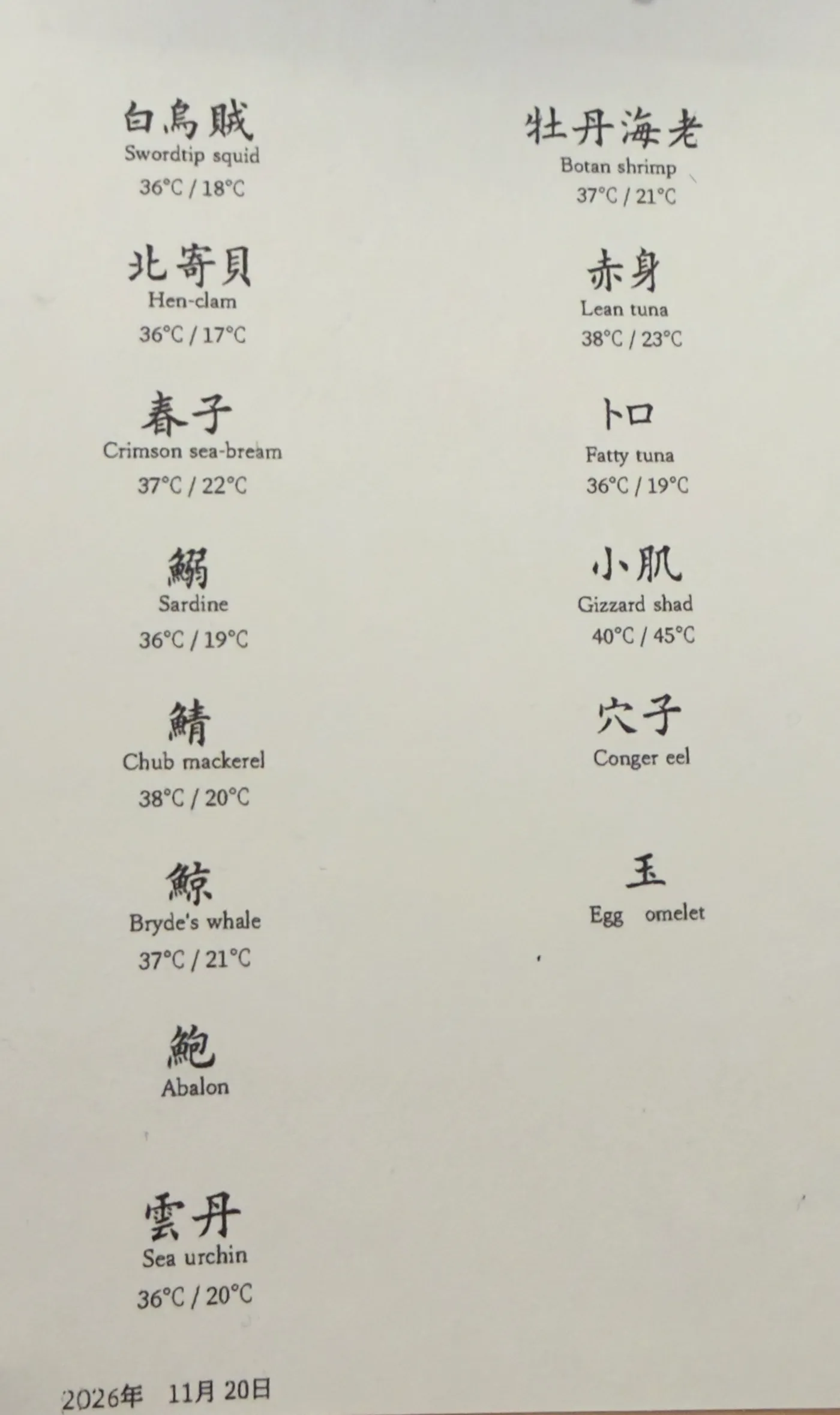
Our November 20 menu, with Namba-san's individual temperatures for fish and rice.
The printed menu included the temperatures Namba-san had chosen for each nigiri. We've discussed those temperatures extensively during previous visits, so this time I concentrated on the ingredients and the stories behind them. Fortunately, Namba-san was happy to talk, often explaining not only what he was serving but why he'd decided to prepare it that way.Otsumami
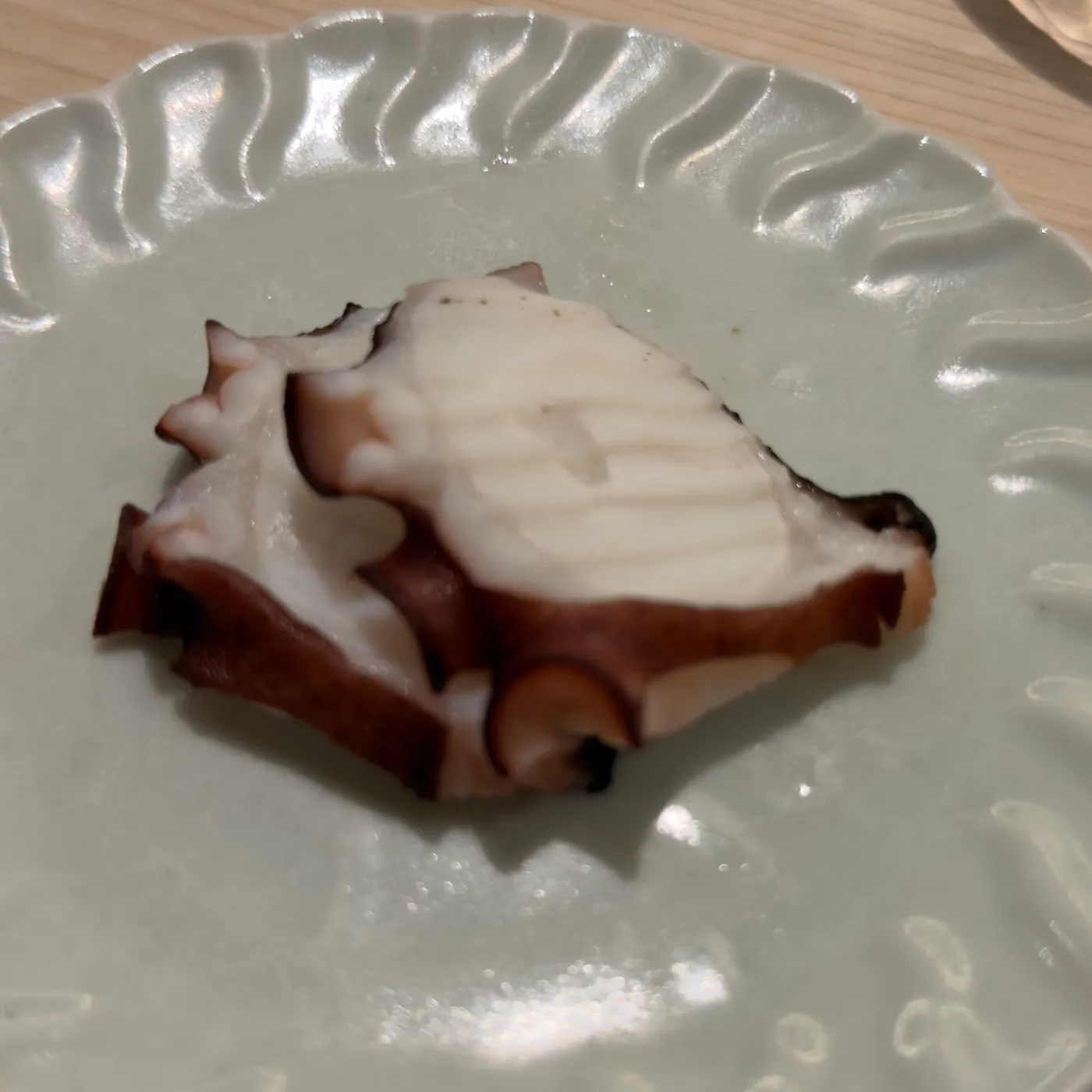
Octopus from Sajima — 蛸
Namba-san explained that the octopus came from Sajima in Kanagawa, where the plankton-rich waters contribute to its character. He wanted us to chew it slowly and enjoy the aroma, and described how he carefully removes the rough outer surface because of the unpleasant sensation it can leave on the tongue. It's exactly the sort of detail we'd never think to ask about until a chef tells us.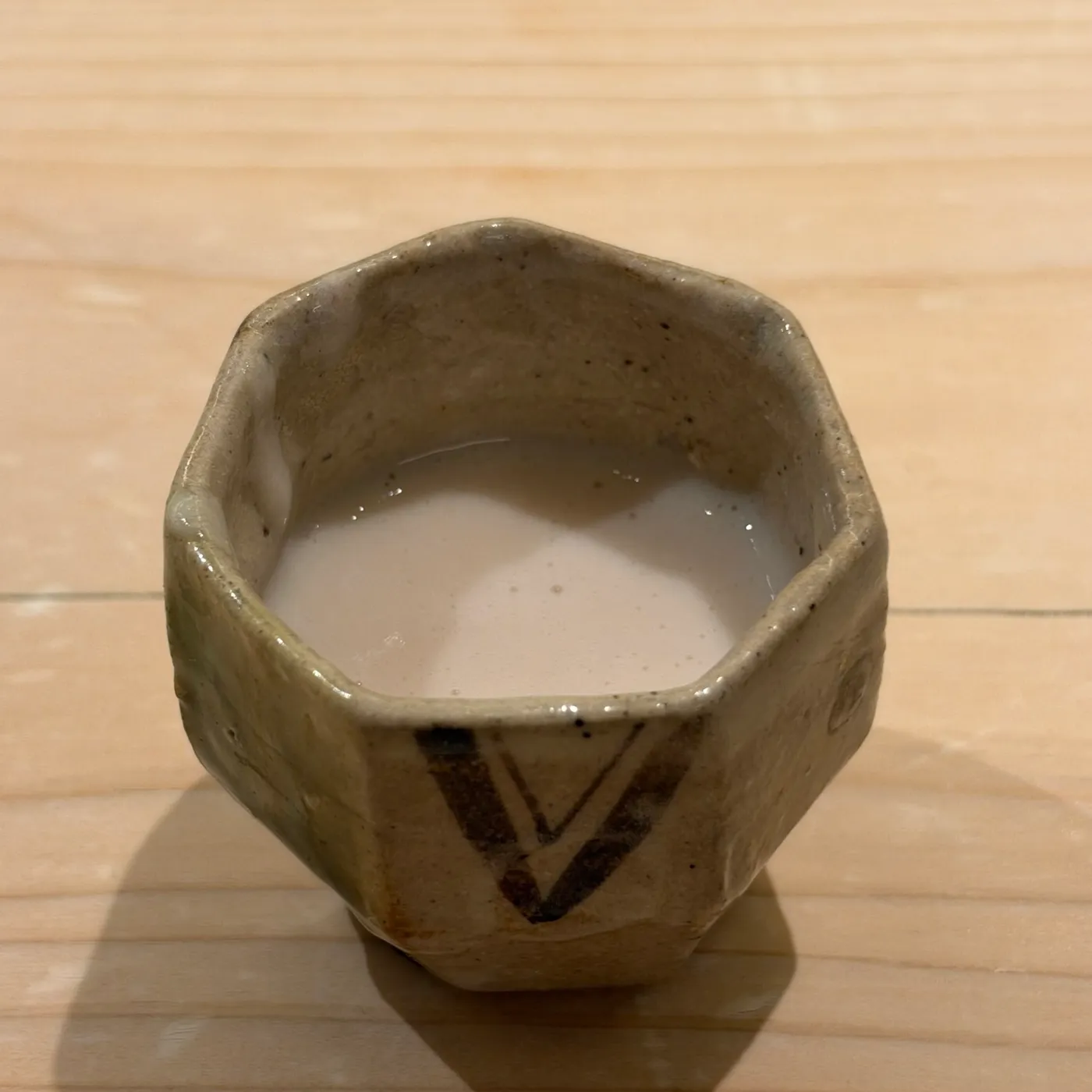
Hokkaido Shirako — 白子
The shirako came from Pacific cod caught off Hokkaido. Namba-san knows that its appearance can put some guests off, so he passes it through a fine sieve, combines it with bonito dashi, and warms it gently while stirring to avoid lumps. What arrives is a smooth, creamy preparation, quite different from the familiar clusters of milt. I've eaten shirako in so many different interpretations on this trip that I may eventually have to dedicate an entire story to it.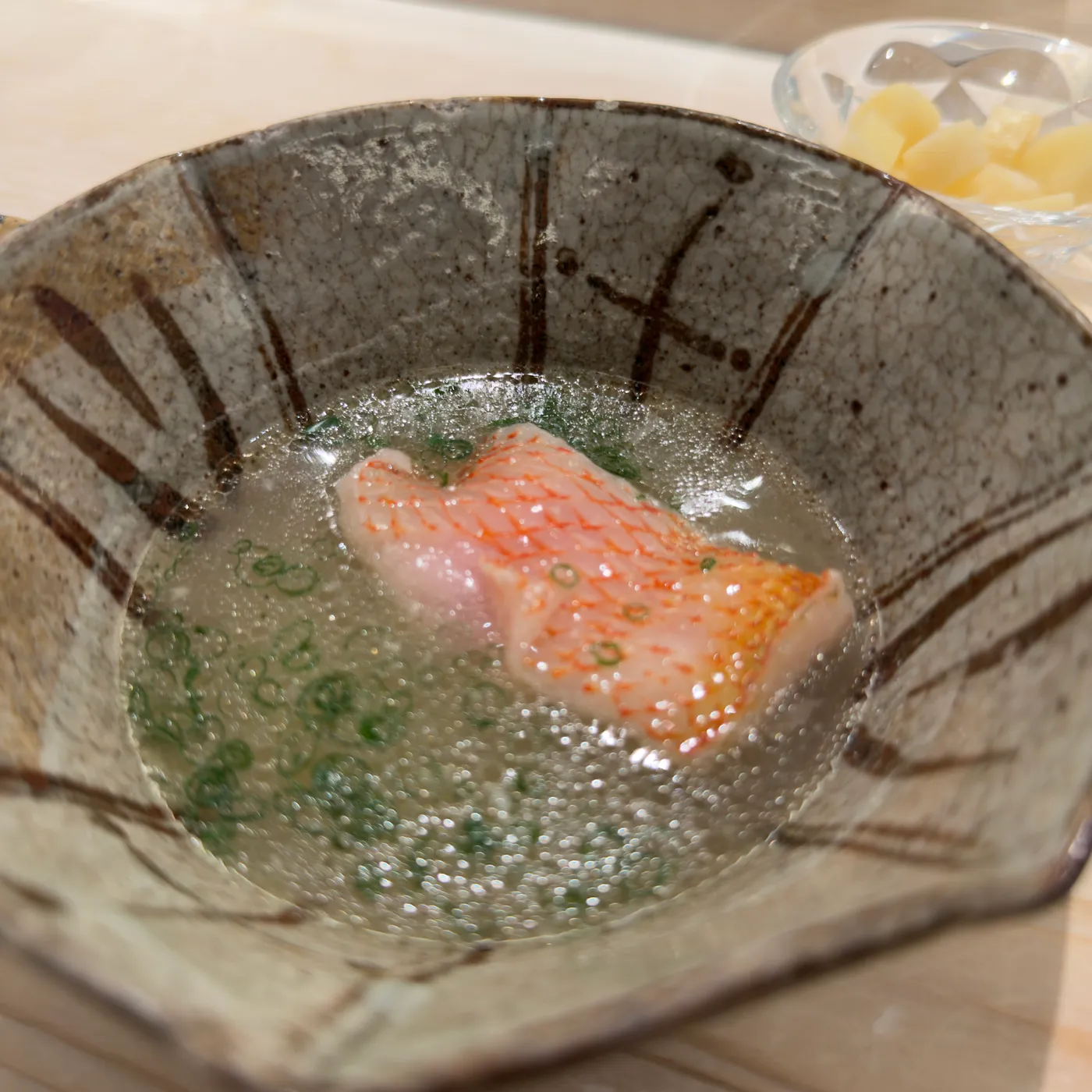
Kinki — キンキ
Namba-san described the kinki, sourced from northern Hokkaido, as one of his specialties. What interested me was his deliberate decision to make the broth a little sweeter than usual. He could add more soy sauce and make it taste like any number of similar preparations, he explained, but he wants people to recognize that particular flavor as Sushi Namba's. I liked that. A chef who wants his guests to remember a dish rather than simply admire it.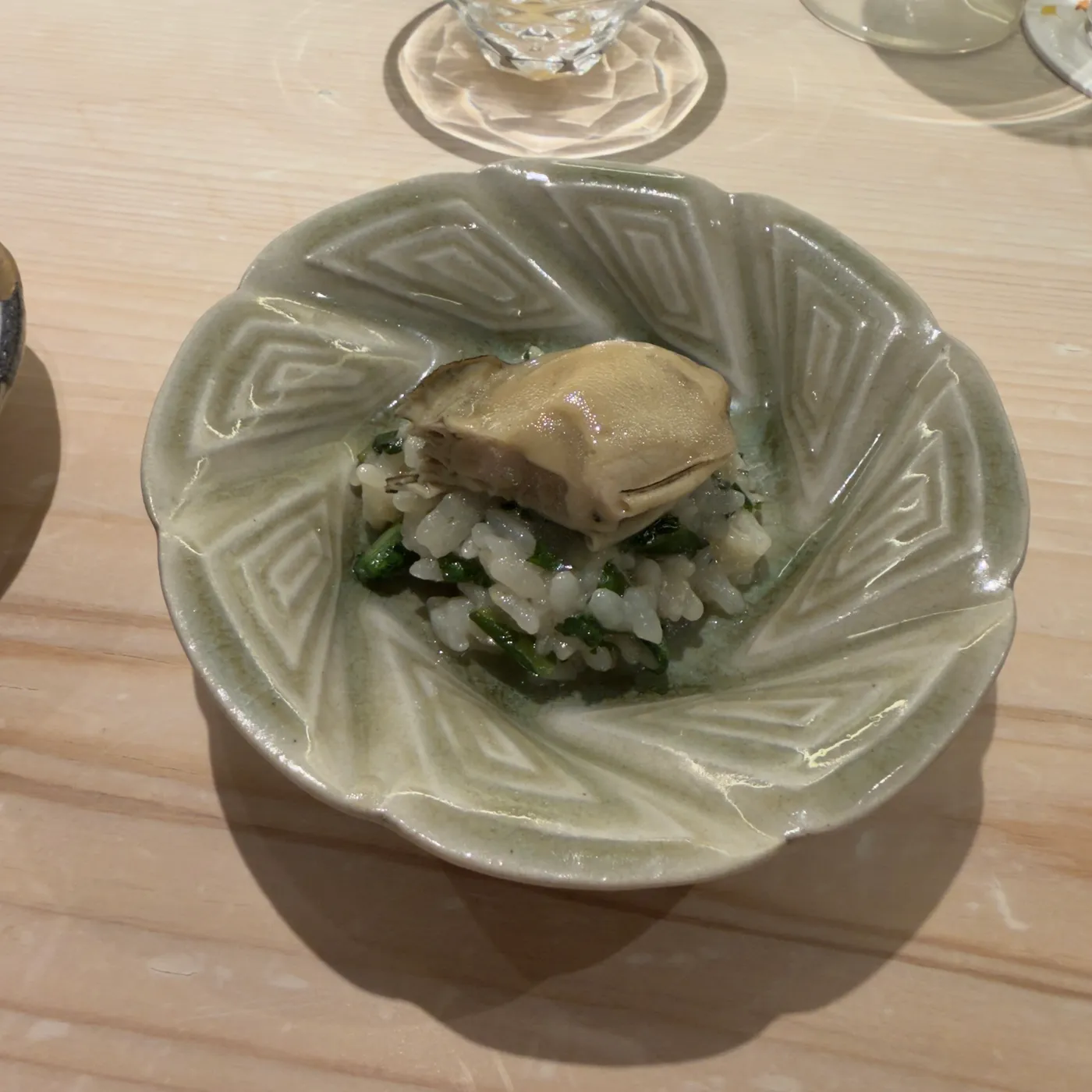
Oyster, Sushi Rice, and Shungiku — 牡蠣・酢飯・春菊
This little preparation combined oyster, sushi rice, and shungiku. Namba-san allows the rice to absorb the juices of the oyster, while the vinegar in the shari balances its umami. It's one of those dishes that sounds perfectly obvious once the chef explains it, although I doubt I would ever have thought of it myself.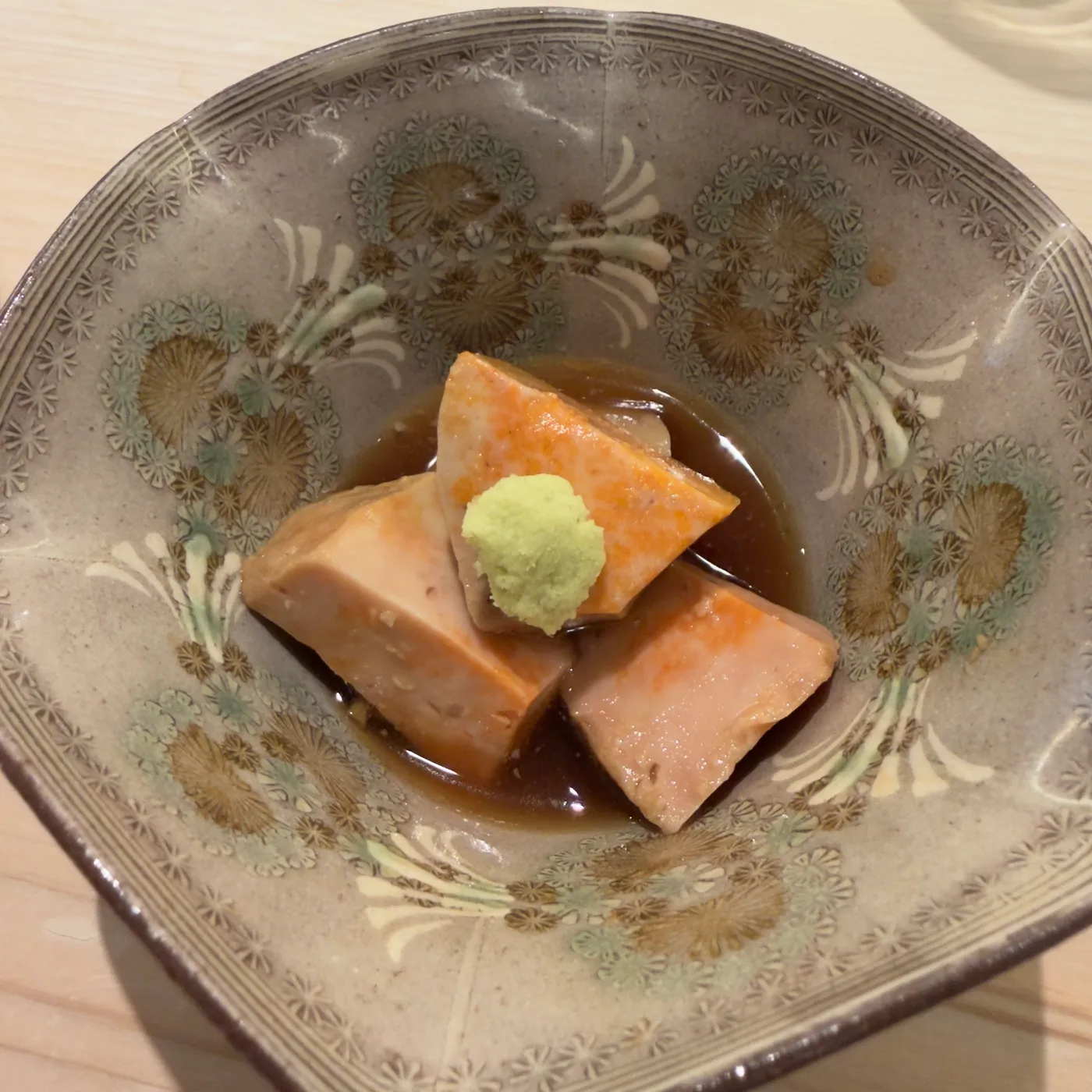
Ankimo from Yoichi — あん肝
The monkfish liver came from Yoichi in Hokkaido, with a slightly sweet seasoning. Namba-san called it the foie gras of the sea.The Nigiri
Shiro-ika — Swordtip Squid
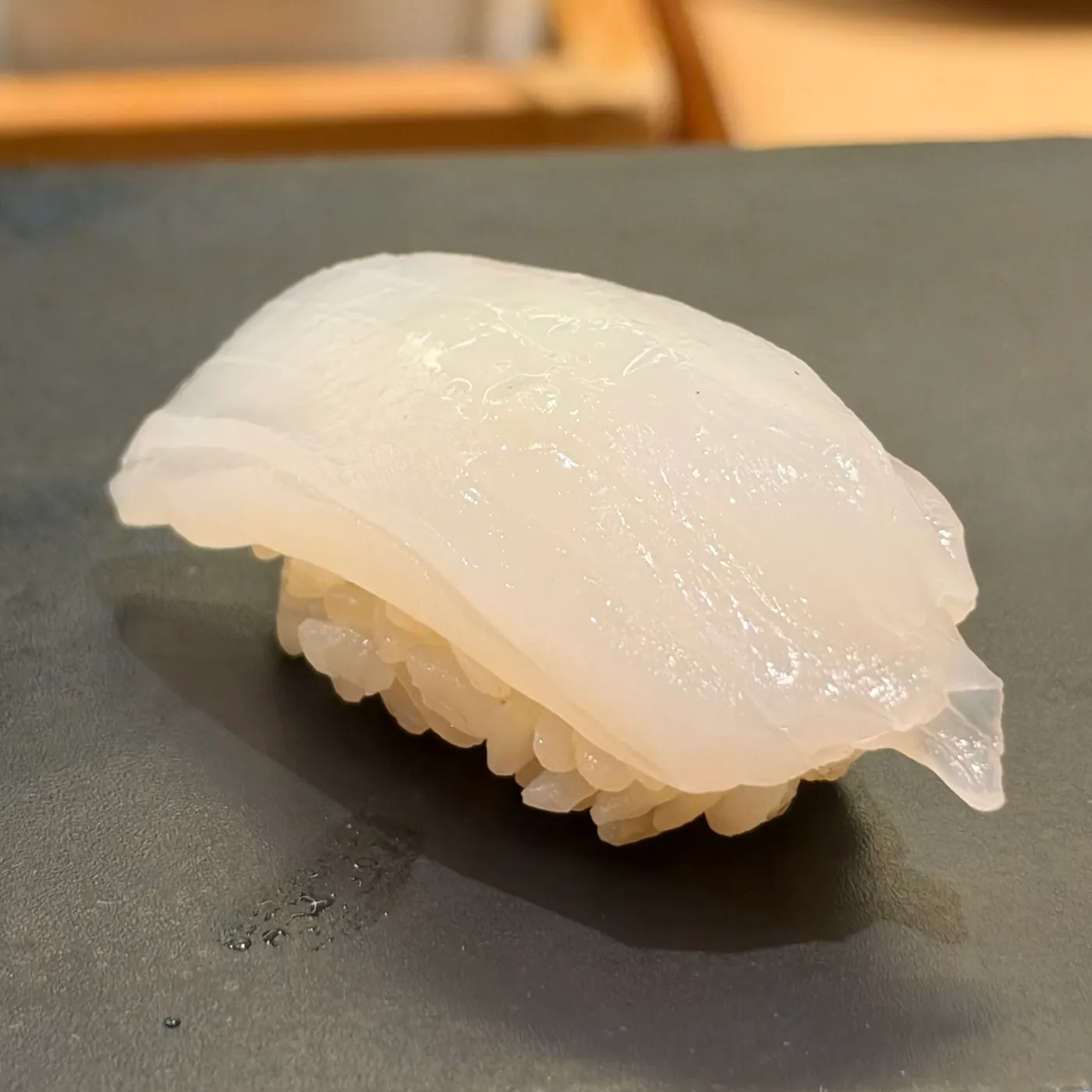
Our first nigiri was shiro-ika, and I noticed that Namba-san had changed the knife cuts from the very fine pattern I remembered from earlier visits. He confirmed that the cuts were now slightly wider and the sections a little thicker, quickly assuring me that this wasn't a compromise. I'd never suggested that it was, but I was amused that he'd felt the need to say so.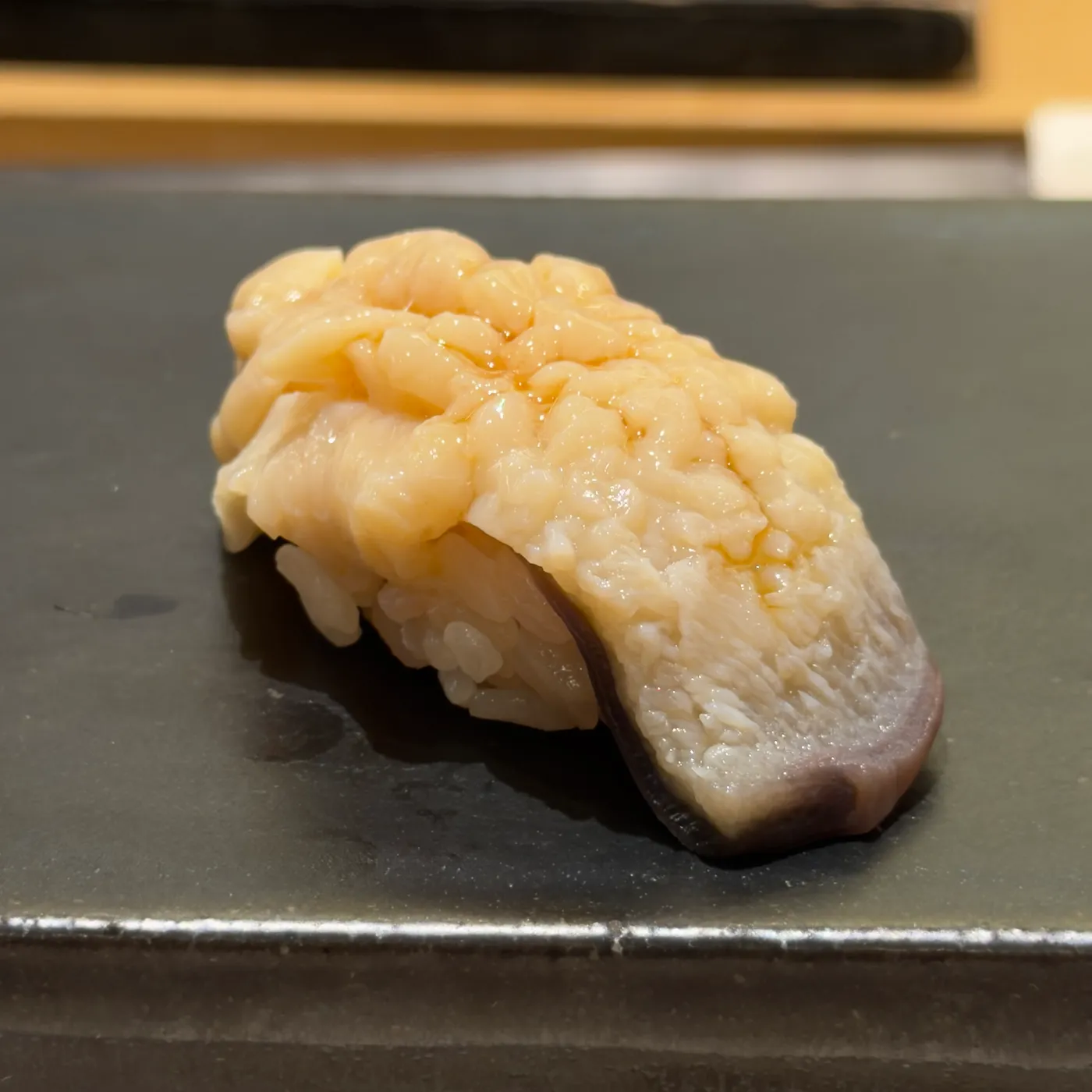
Hokkigai — Hen Clam
The hokkigai followed, its distinctive texture providing a contrast to the delicate squid.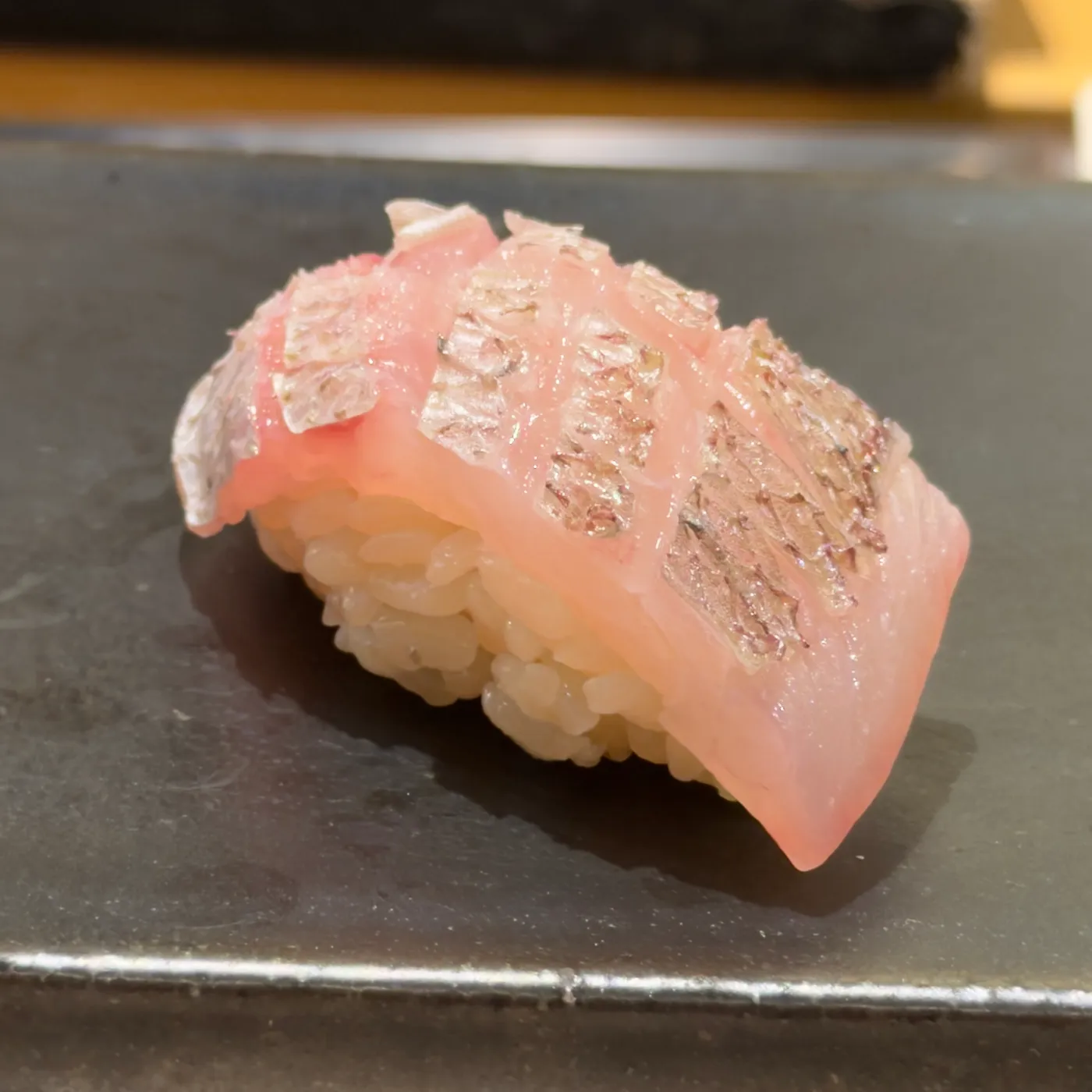
Kasugo — Young Sea Bream
The kasugo had been gently scented with kombu, and Namba-san described the texture he was looking for as soft and fluffy.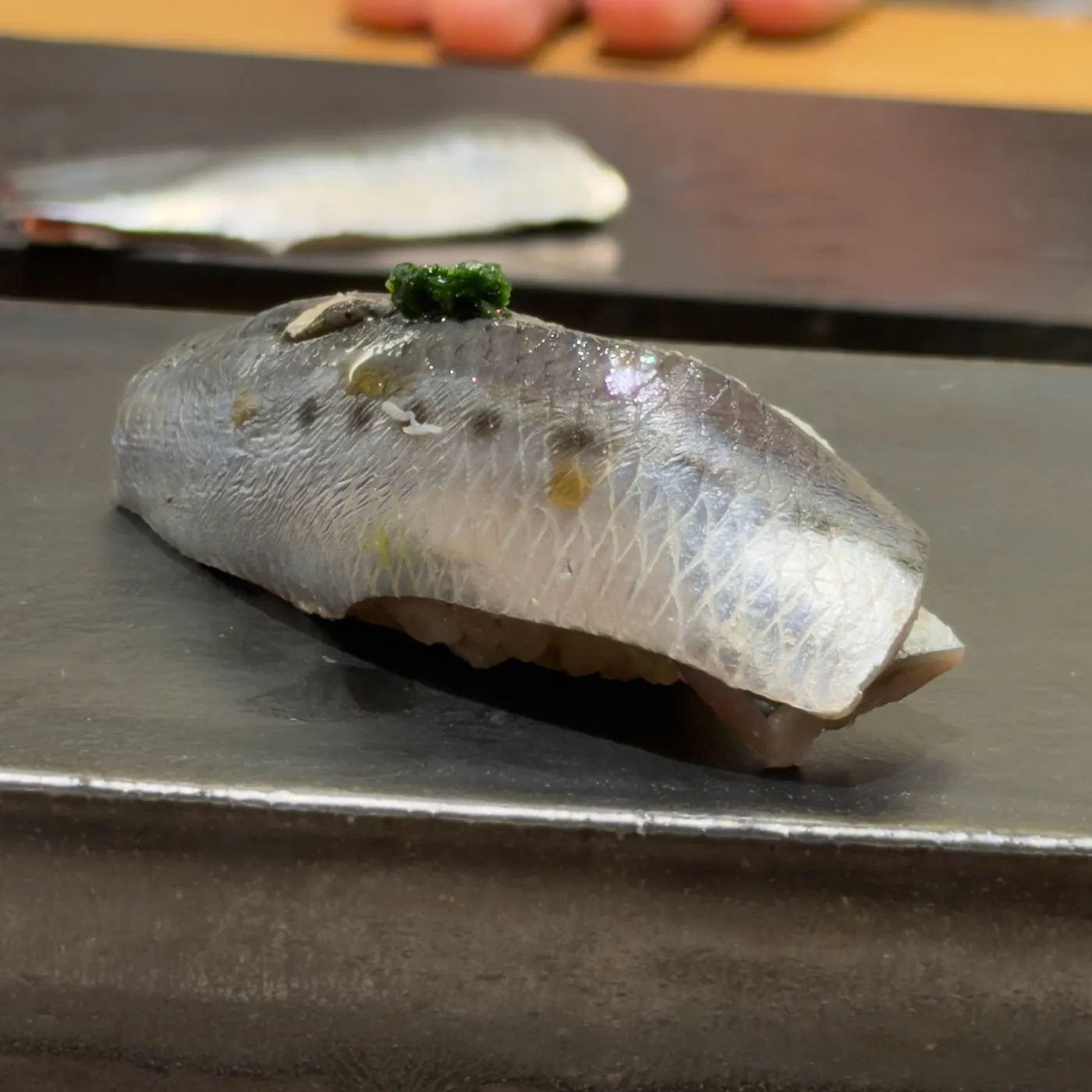
Koiwashi — Small Sardine
Namba-san prefers small sardines because their fine bones make them more pleasant to eat and because he likes their appearance as nigiri. He also insists on preparing them on the day they're served. Sardines deteriorate quickly as their bloodline oxidizes, he explained, and aging them doesn't improve their flavor. In a world where seemingly everything that swims is being aged, I rather enjoyed his insistence that a sardine should simply be eaten fresh.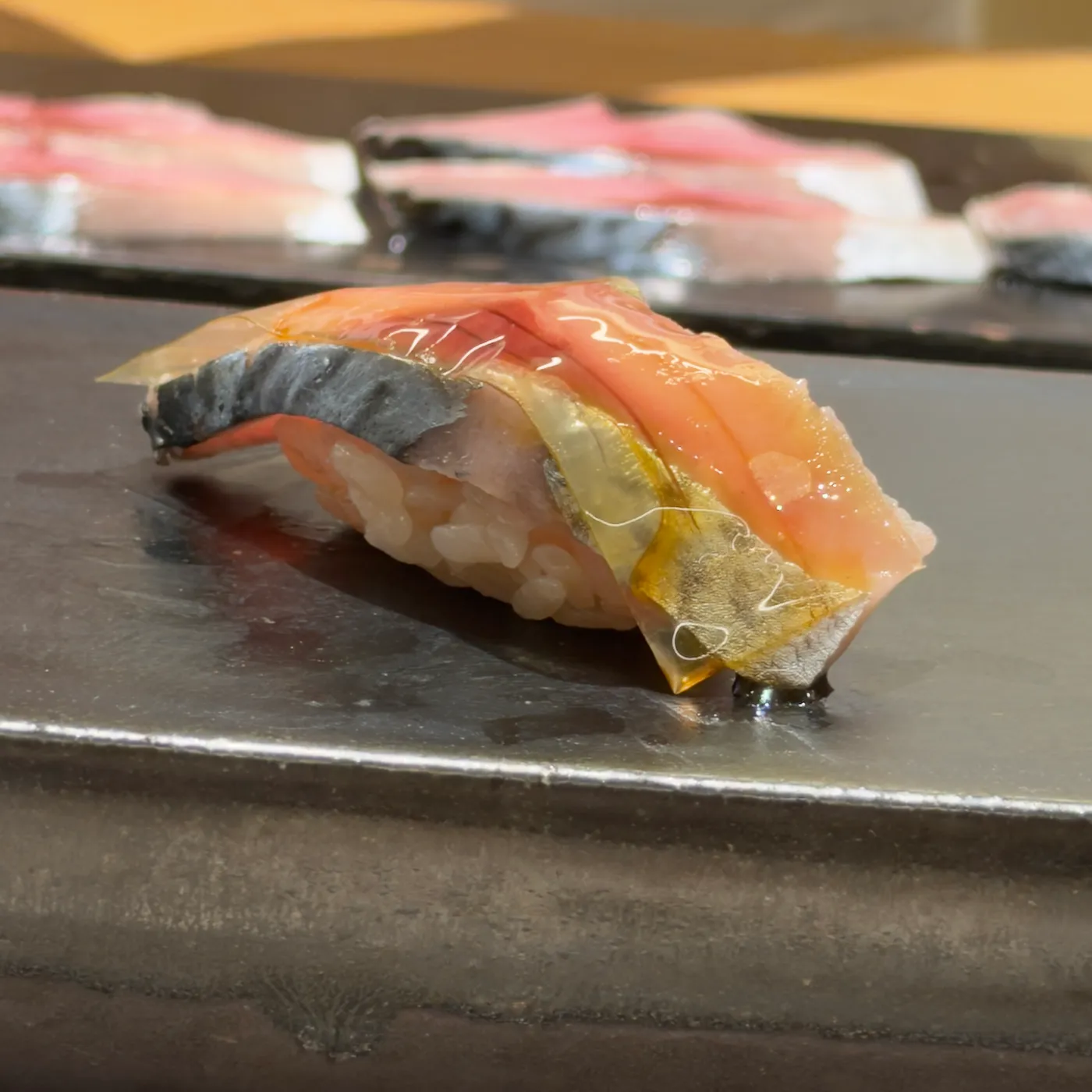
Shimesaba — Cured Mackerel
The mackerel prompted one of Namba-san's longest explanations. He selects it in excellent condition, fillets and salts it, then freezes it to address the risk of Anisakis parasites. He also carefully controls the vinegar-curing time, but what matters enormously to him is when the fish is sliced. He waits until immediately before making the nigiri because the bloodline oxidizes quickly, changing from red to brown. He wants the flesh to remain pink and the bloodline bright red. This particular fish was gomasaba, or spotted mackerel, and he was extremely pleased with it. Judging by the reactions around the counter, our guests agreed.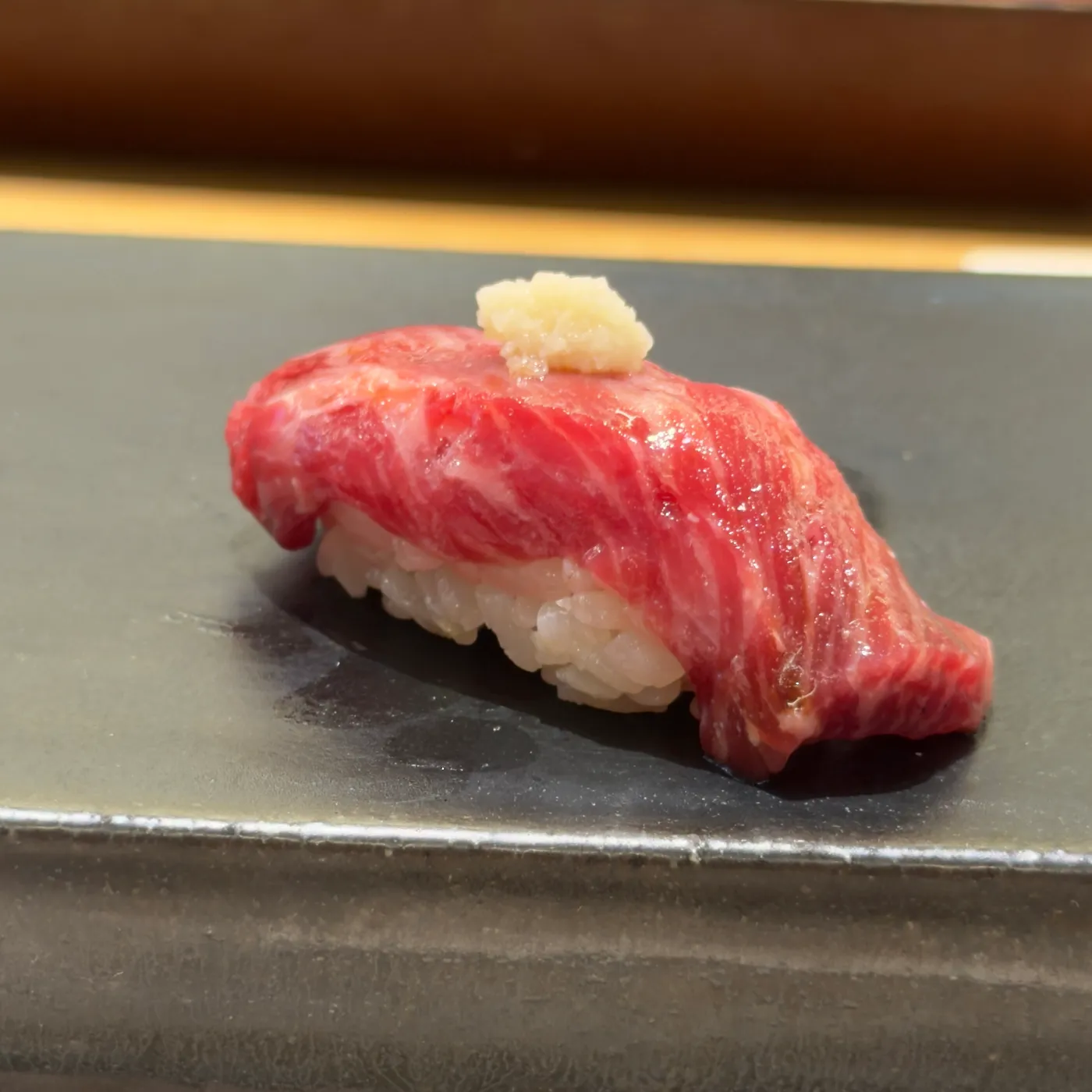
Whale — Kujira / 鯨
The whale came from the tail section, known as onomi, which Namba-san described as particularly tender. He explained that it was an unusually scarce selection, sourced through Toyosu, and that only a few restaurants, including Amamoto, used the same product.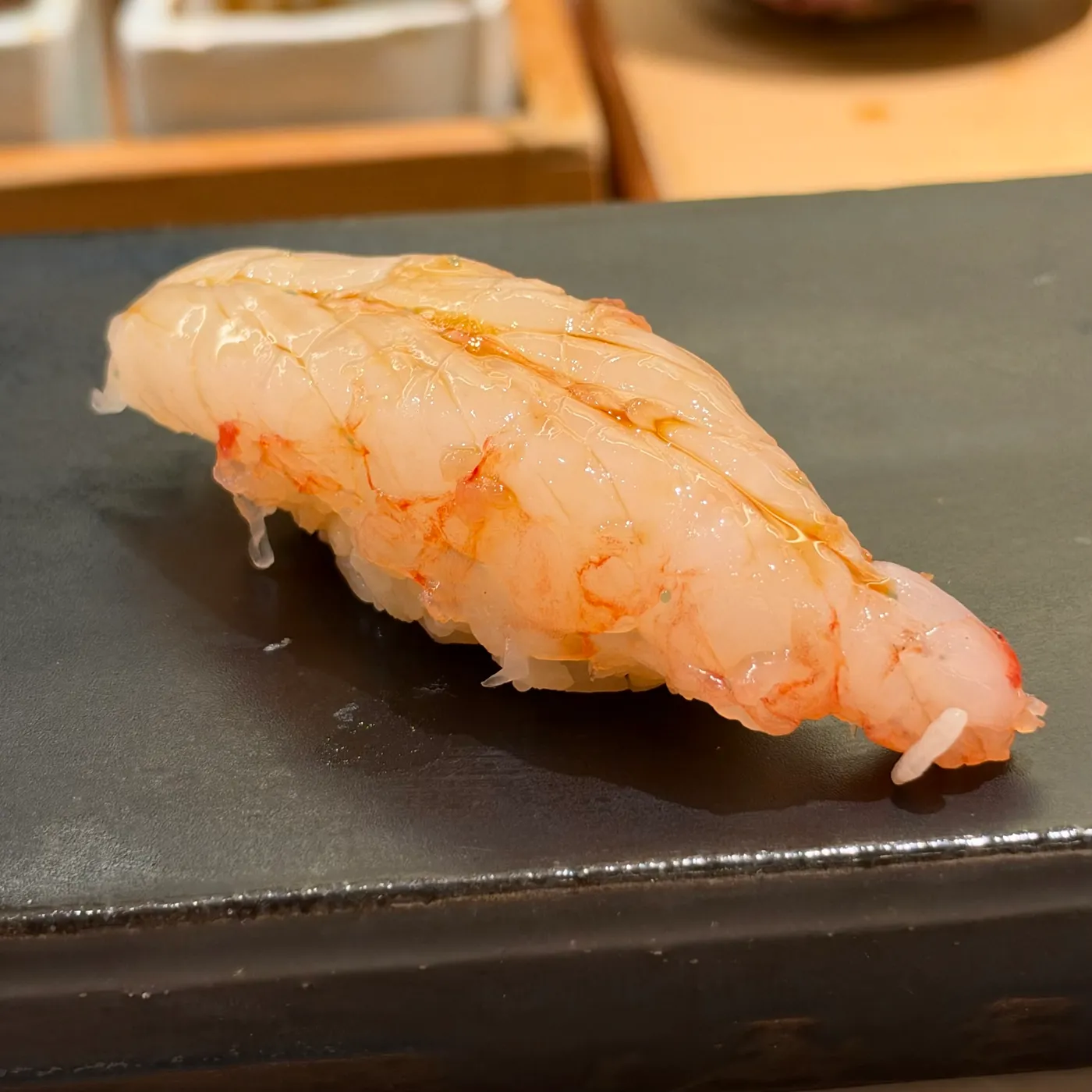
Botan Ebi — Botan Shrimp
The botan ebi was enormous, and Namba-san explained that its size was essential to the creamy, almost sticky texture and sweetness he wanted. He also wondered what a shrimp of this quality might cost in New York. When we heard the numbers, someone suggested that he should stay in Tokyo. We all laughed.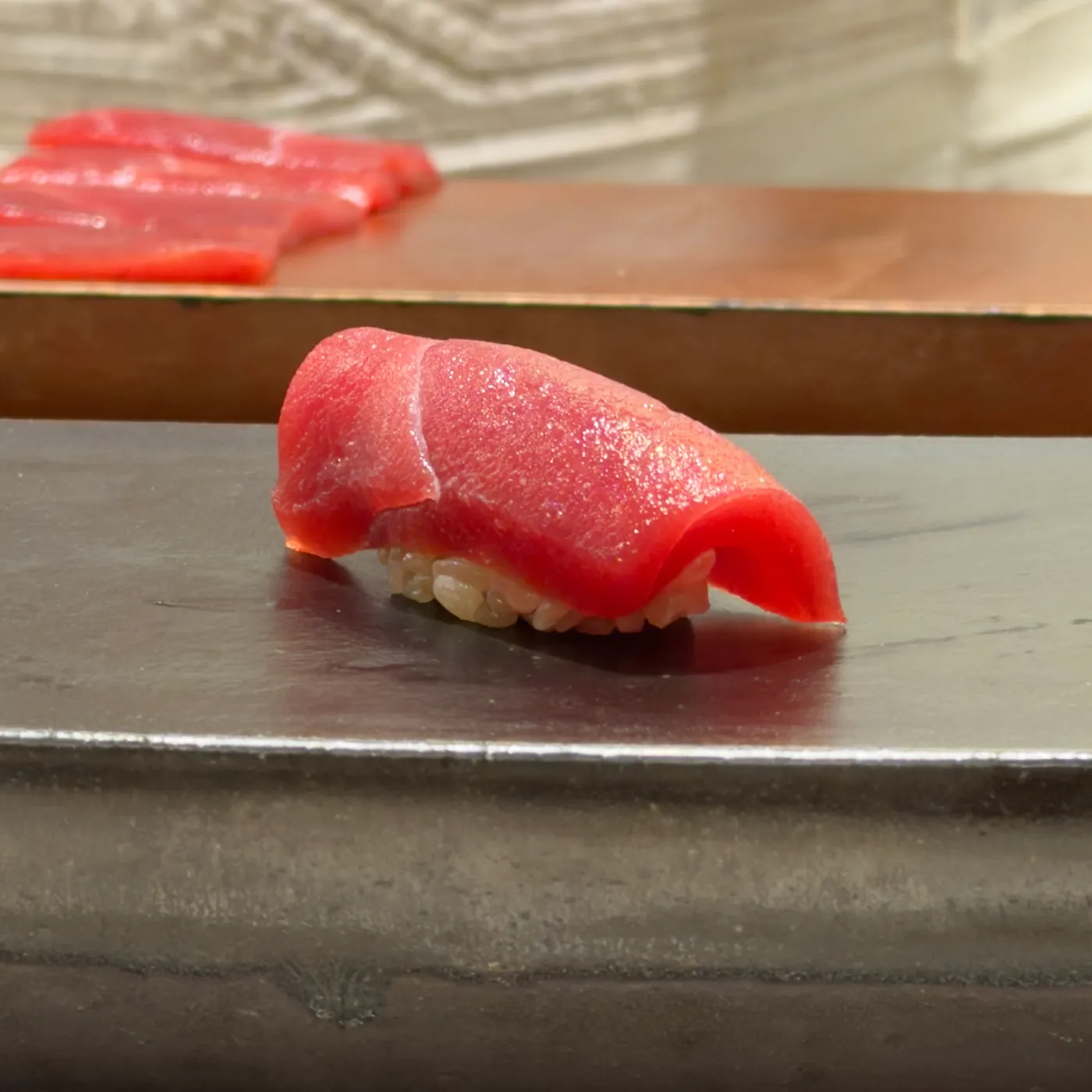
Akami — Lean Tuna
After everything Namba-san had told me about his Instagram photographs, I was looking at the tuna with renewed curiosity. He discussed tuna from Hachinohe in Aomori and Toi in Hokkaido, including the differences between fish that had rested and those served sooner.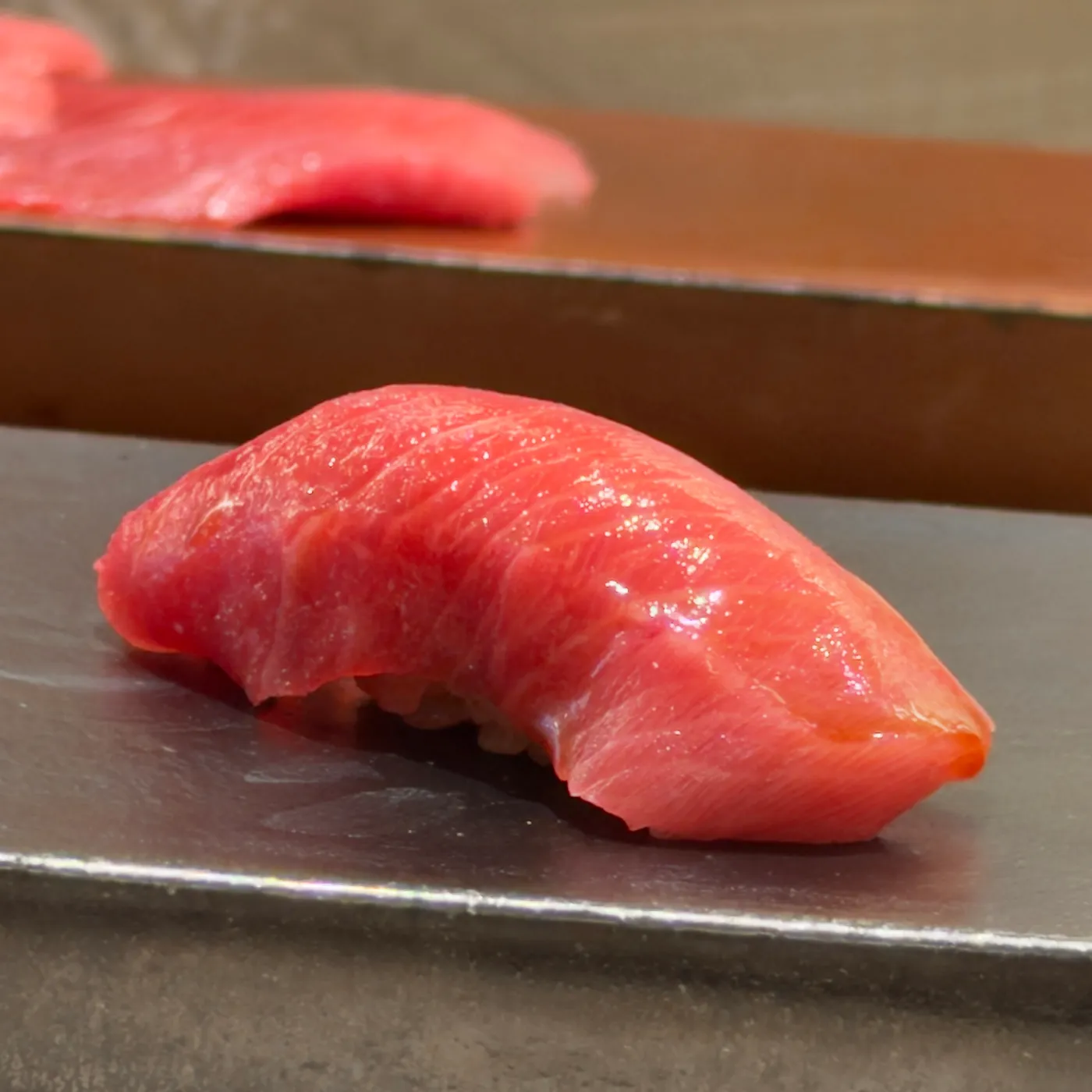
Chutoro — Medium-Fatty Tuna
Namba-san explained that even toro requires careful attention to where the meat comes from and how it is cut. Some pieces can be served thicker, while those with more sinew need thinner slices.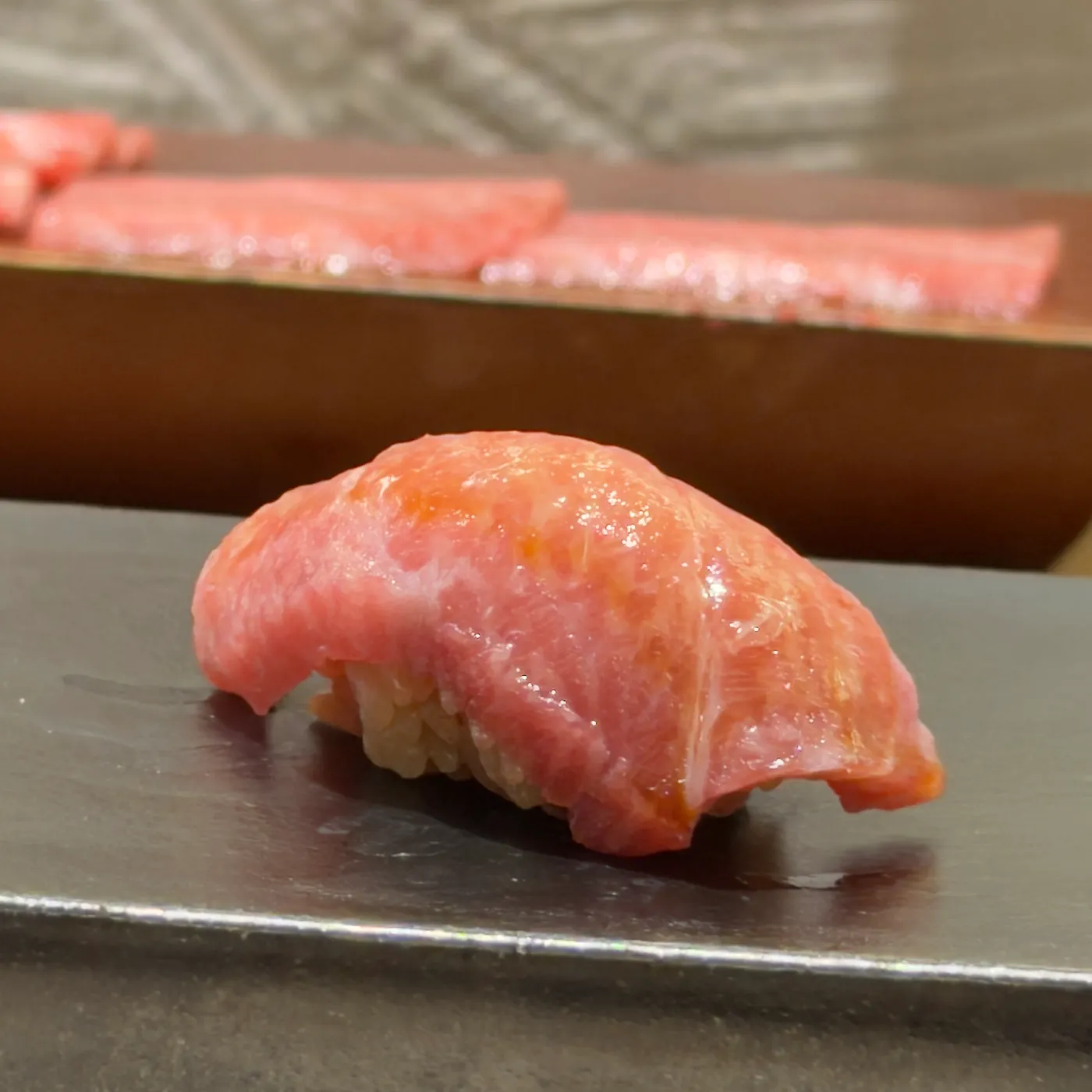
Otoro — Fatty Tuna
At one point, he compared two selections of tuna, describing the fat in one as wilder and more assertive, while the other was cleaner and more delicate. I still couldn't see everything Namba-san saw, but at least I had some idea of what I was supposed to be looking for.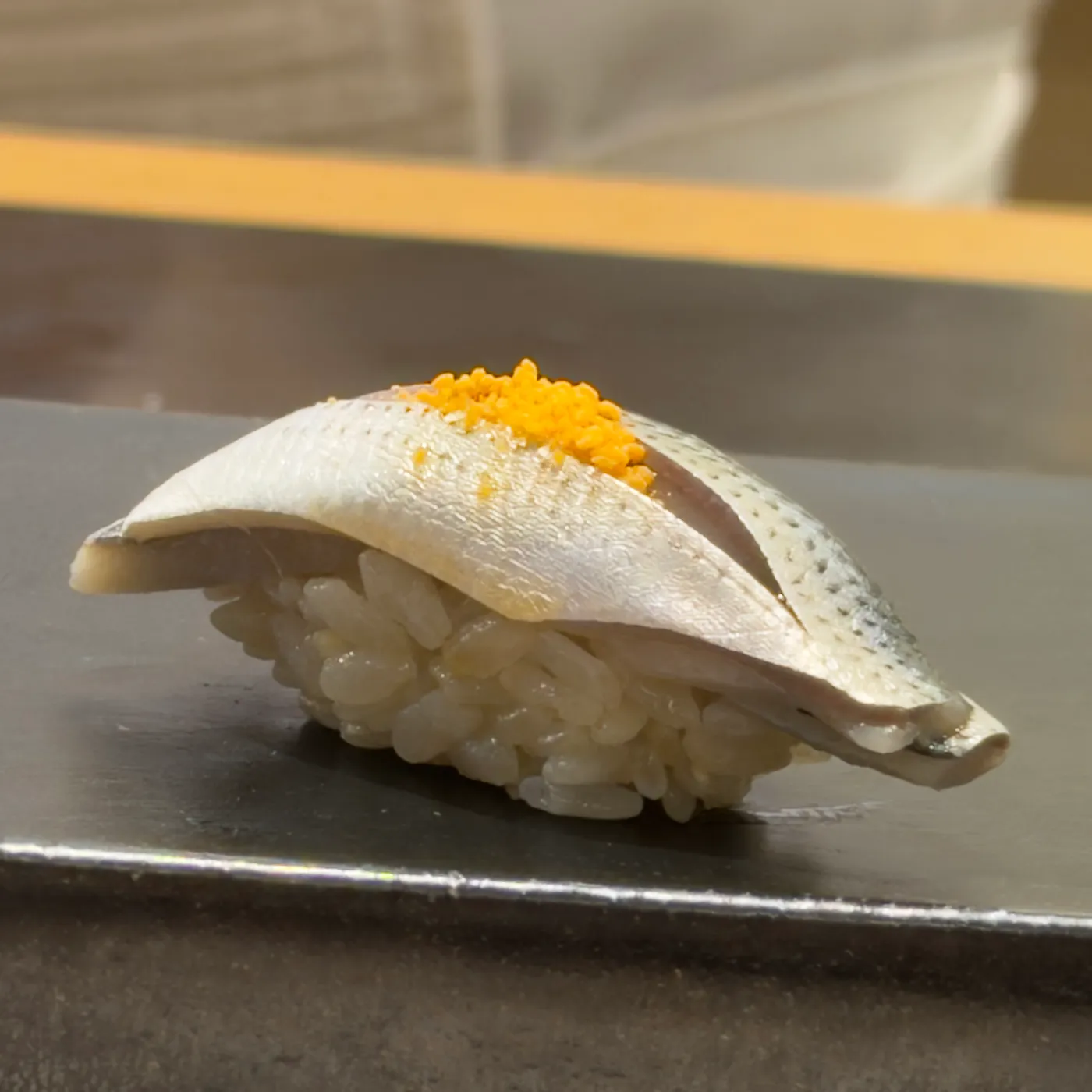
Kohada — Gizzard Shad
With the kohada, Namba-san talked about the shrimp oboro. Unlike the moister preparations common at many sushi restaurants, he dries his oboro much more thoroughly, until it becomes almost powdery. Another small decision that changes the way the finished nigiri eats.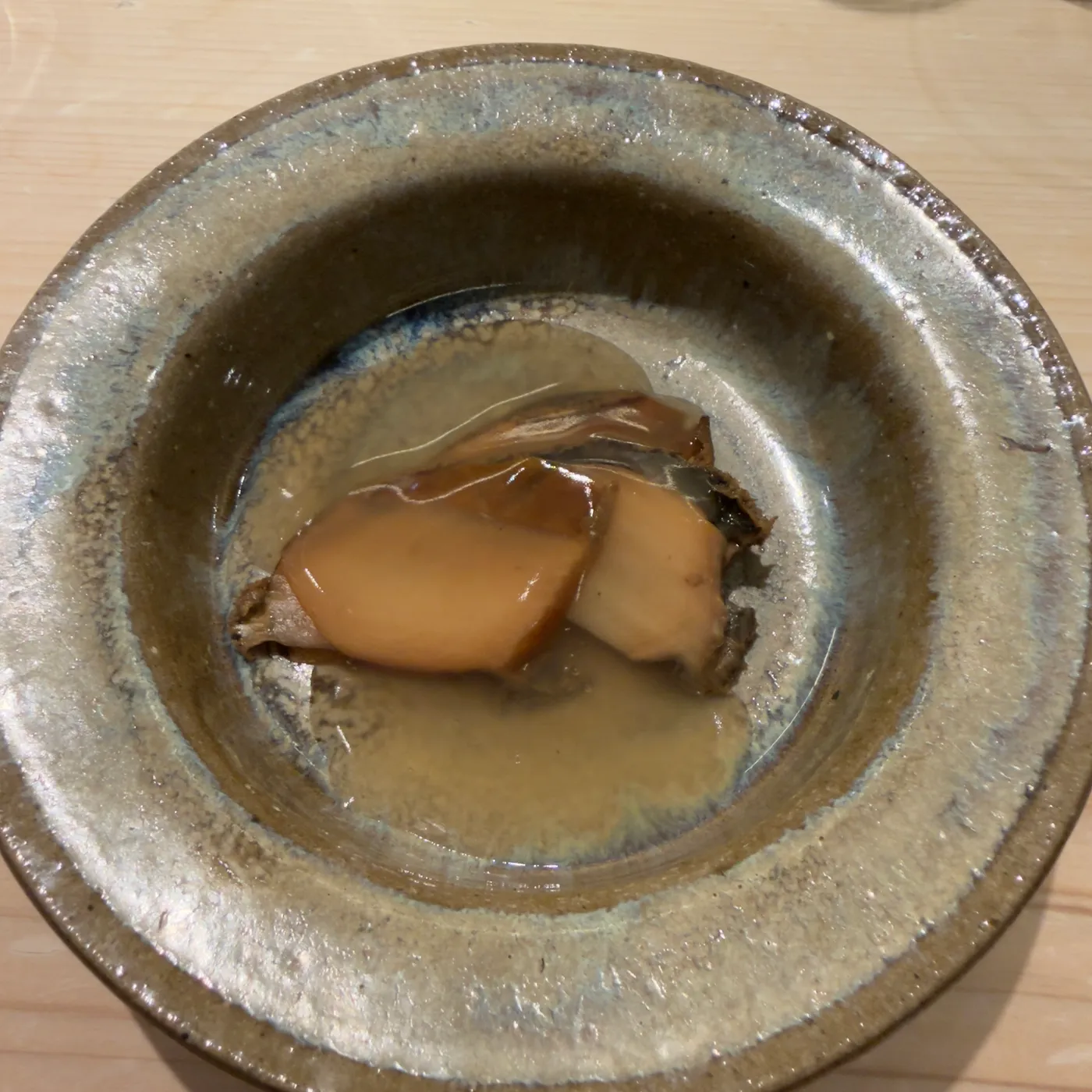
Abalone — Awabi / 鮑
Abalone was also included on Namba-san's printed menu. Its firm, distinctive texture provides another contrast to the softer pieces of fish and the richer tuna.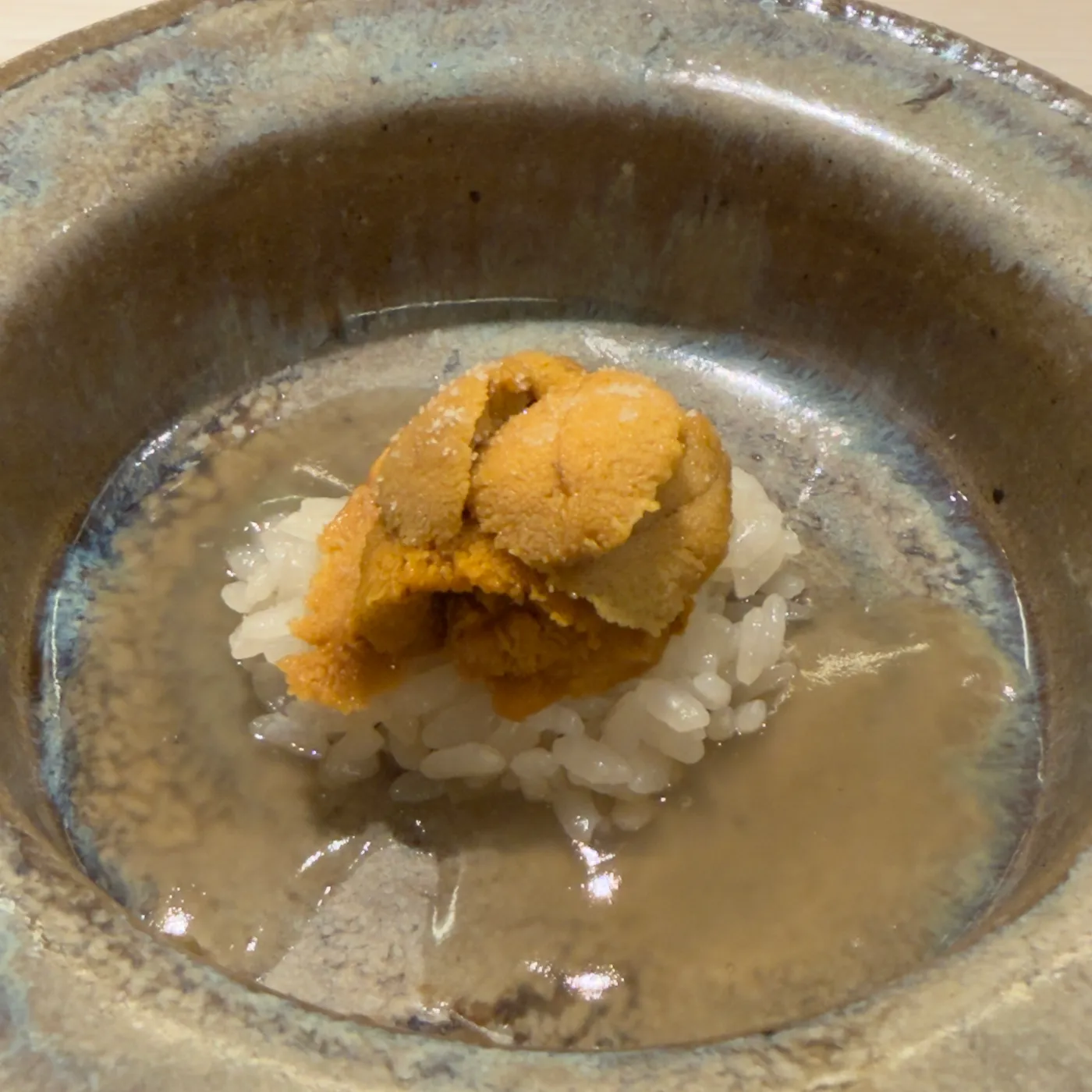
Uni — Sea Urchin
The uni came from Hakodate, and Namba-san wanted us to understand that he'd selected it for its sweetness and flavor rather than the name on the box. There are several famous names in the sea urchin trade, he explained, but a less celebrated producer can sometimes supply something better. I'd much rather eat the better uni than the more famous one.Sawara — Spanish Mackerel / 鰆
The sawara appeared in different preparations, and Namba-san's explanations were particularly interesting. One was seared over burning straw, giving the surface a smoky aroma while leaving the center almost raw, then finished with grated onion and soy sauce. Another was cooked gently to preserve its moisture, with additional heat applied to the skin until crisp. He explained that overcooking the flesh makes it dry, while the skin benefits from more heat. He also used the tender portions of cooked sawara in a small rice preparation, setting aside the firmer pieces.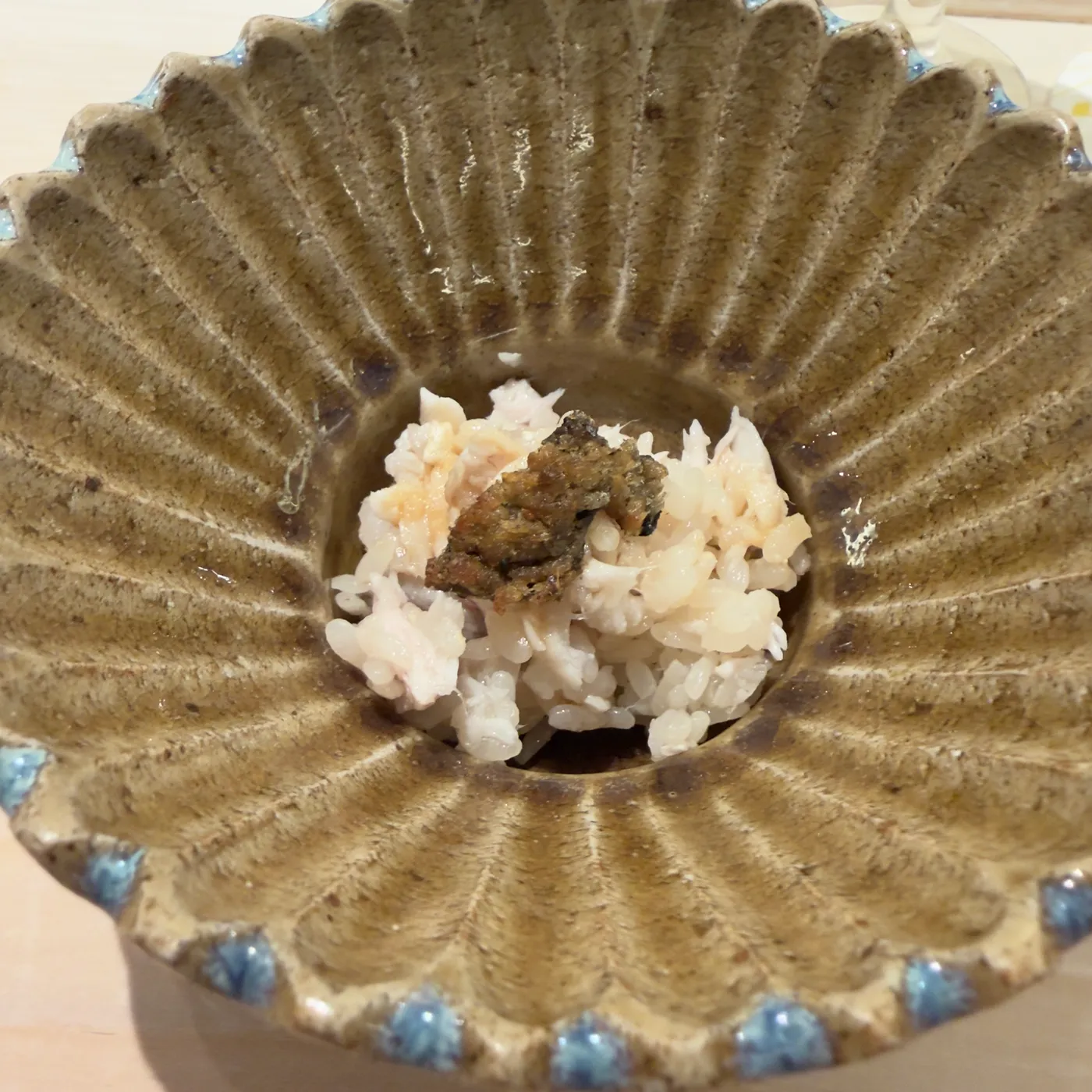
Sawara with rice.
Maguro Okaki — マグロおかき
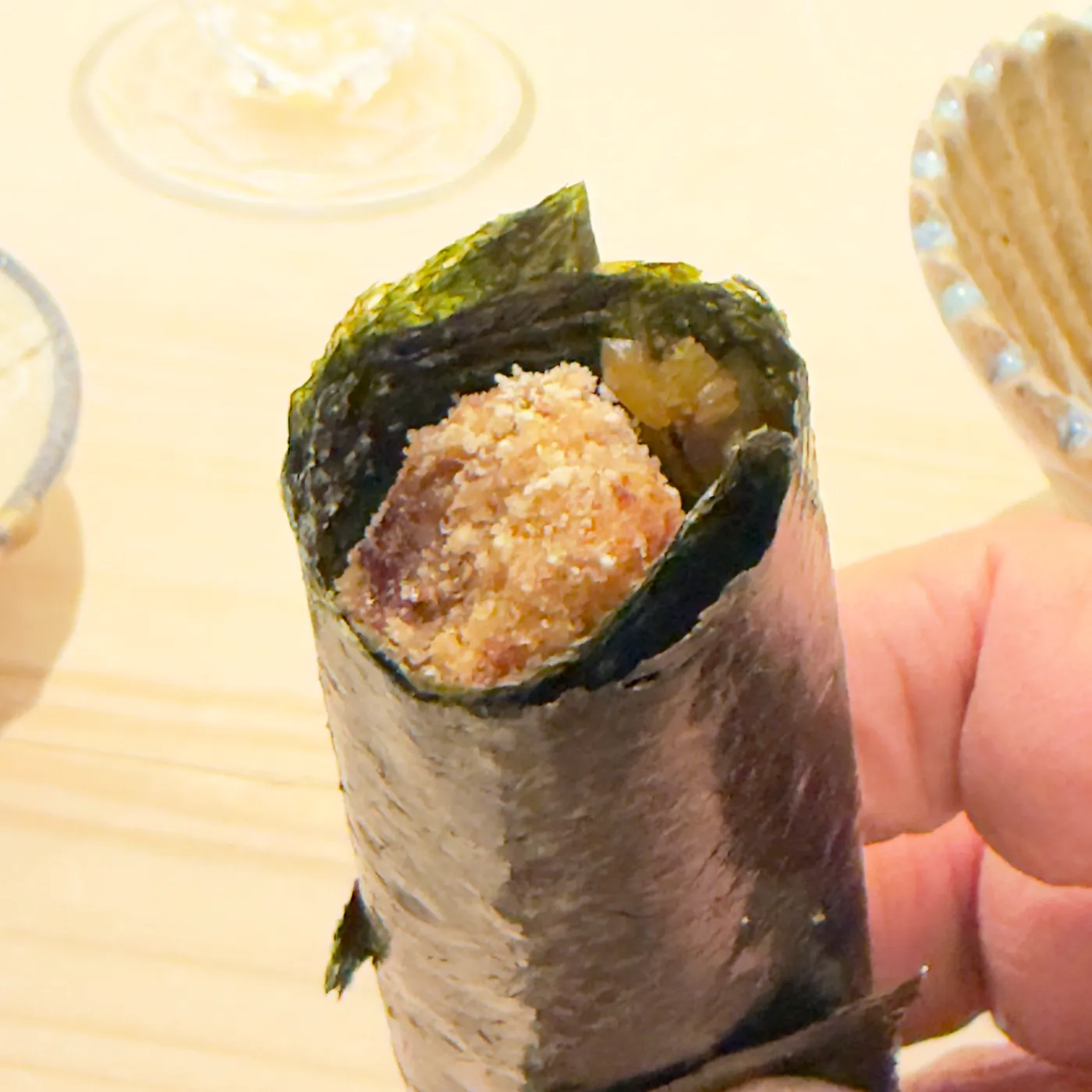
And then came an invention I would happily eat every day. Namba-san's maguro okaki began as a simple preparation of tuna tatsuta-age. Over time, he tried different accompaniments, including onion, before deciding that wasabi stems worked best. But he was particularly enthusiastic about the seaweed. He buys Ariake nori from Marutomo Noriten, where it's roasted and immediately vacuum-sealed. The restaurant receives packets containing exactly enough for one seating, which are opened immediately before serving. Namba-san believes this preserves the flavor better than roasting the sheets again over charcoal at the counter. The result is a marvelous combination of textures: crisp seaweed, crunchy fried tuna, juicy fish inside, and the wasabi bringing everything together. Someone suggested that he should open a shop selling nothing but these. I immediately announced that I'd buy thirty, and Namba-san suggested New York. Considering he was already preparing to open in Miami, perhaps we were getting a little carried away.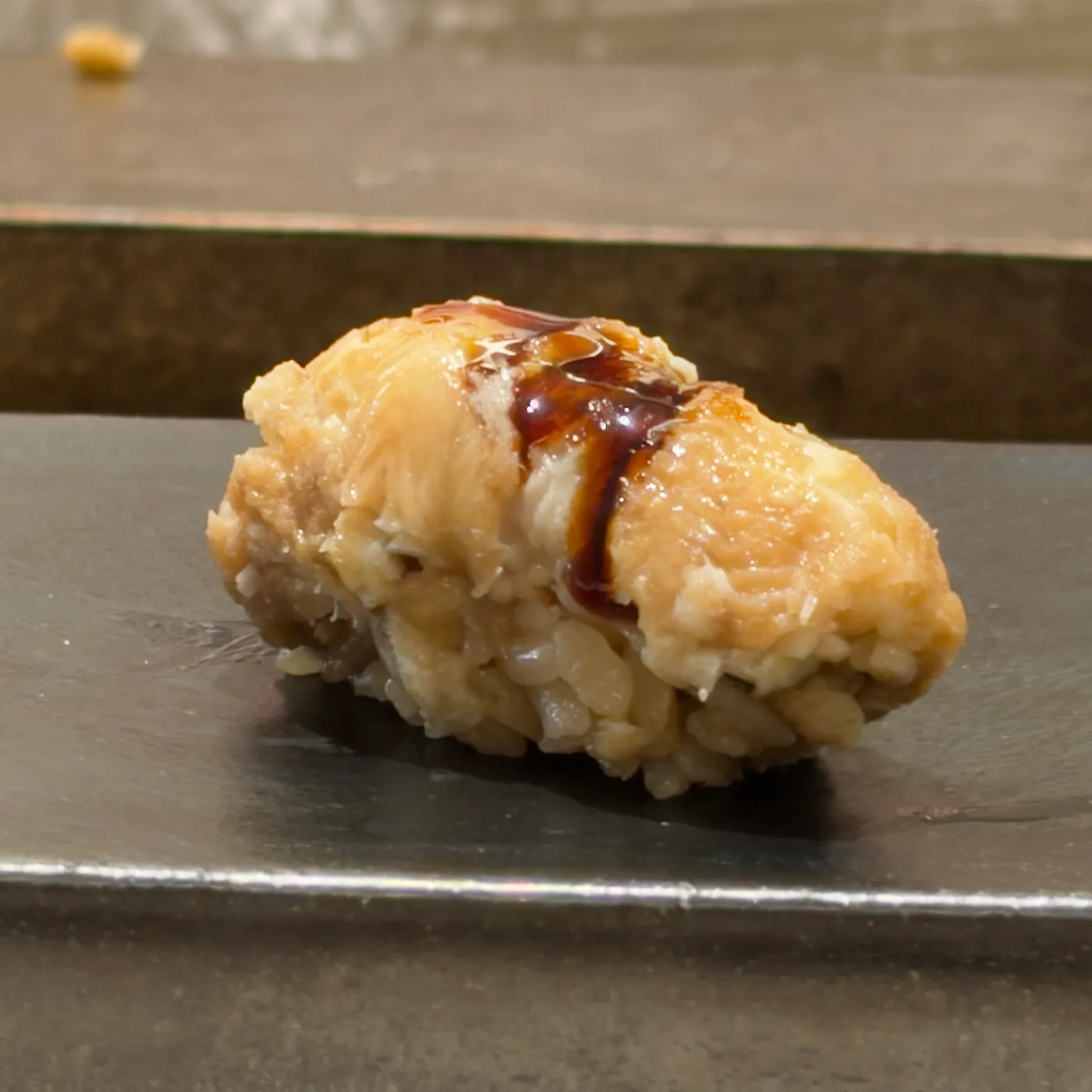
Anago — Conger Eel
Tamago — Egg
What we drank
Namba-san told us that although he enjoys wine, sake remains his preference with sushi. We enjoyed several bottles over lunch, each offering a different expression of Japanese rice and brewing.
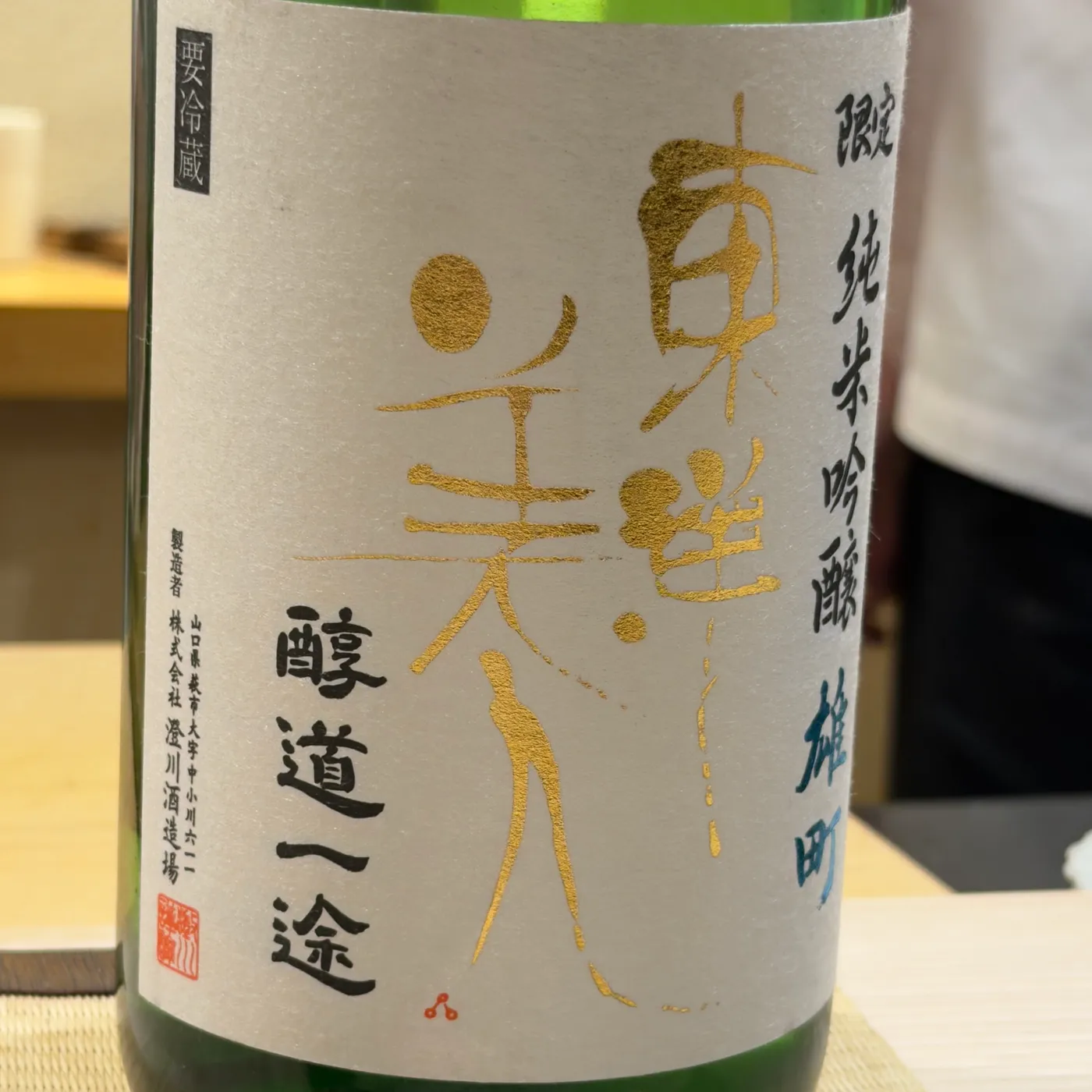
Toyobijin — Jundo Ittō Junmai Ginjo Omachi
東洋美人 醇道一途 純米吟醸 雄町 — Yamaguchi Prefecture
Toyobijin is brewed by Sumikawa Shuzo in Hagi, Yamaguchi Prefecture. This Junmai Ginjo belongs to its Jundo Ittō series and uses Omachi, one of Japan's historically important sake-rice varieties. Omachi often produces sake with a distinctive breadth of flavor and a sense of richness, making it an interesting choice alongside sushi.
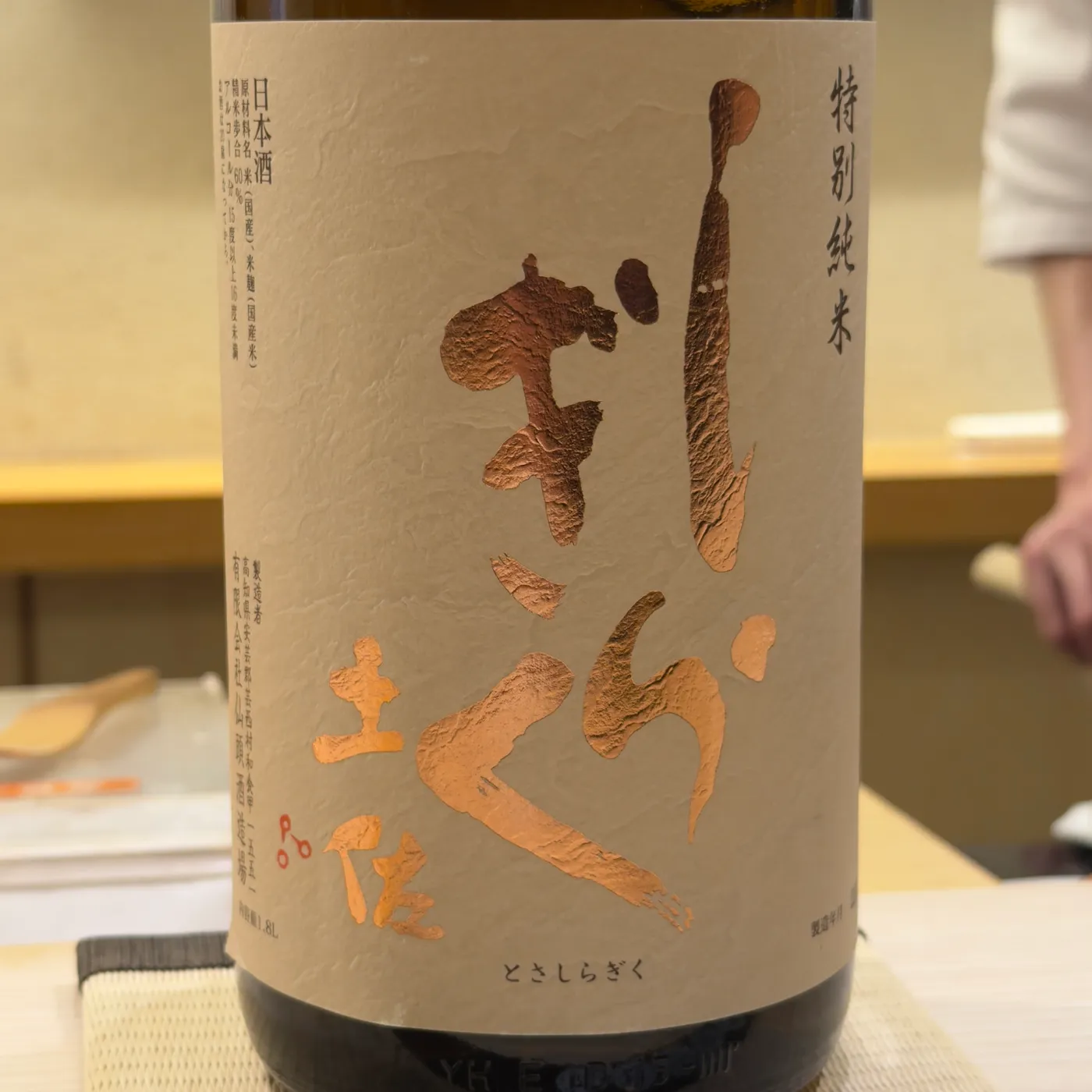
Tosa Shiragiku — Tokubetsu Junmai
土佐しらぎく 特別純米 — Kochi Prefecture
Brewed by Sento Sake Brewery in Geisei, Kochi Prefecture. Tokubetsu Junmai indicates a specially designated junmai brewing method, without added distilled alcohol. It offers a useful contrast to the Junmai Ginjo styles, emphasizing the relationship between rice, fermentation, and food.
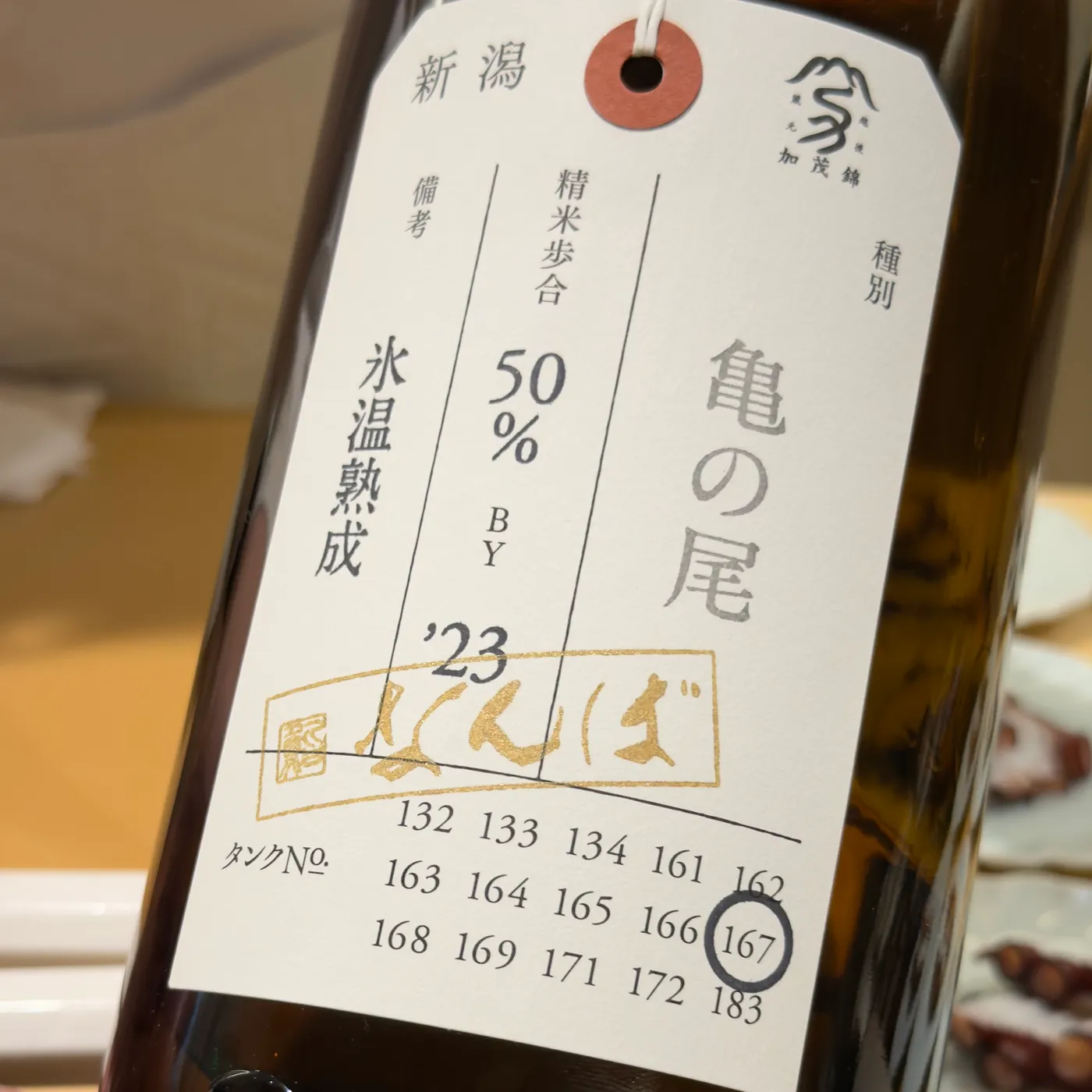
Kamo Nishiki — Namba Selection, Kamenoo
加茂錦 — 亀の尾・氷温熟成
This Namba selection carries details of Kamenoo rice, 50% rice polishing, and maturation at low temperature. Kamenoo is a historic Japanese rice variety prized by some brewers for the distinctive character it brings to sake. The bottle's numbered production information makes this an especially interesting selection to document alongside the meal.
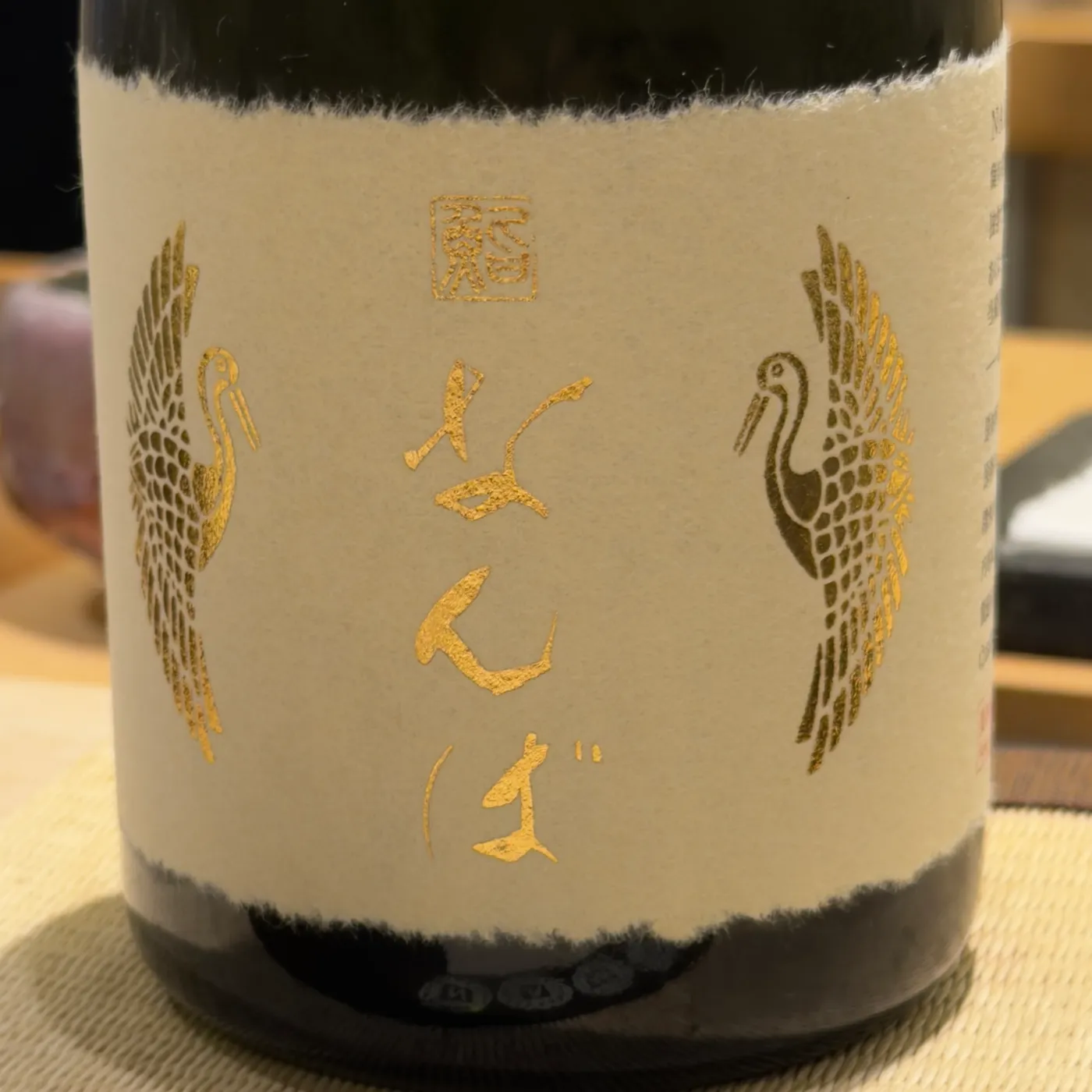
Namba-Labeled Sake
The bottle bears a distinctive gold label with cranes and Namba's name. Unlike the standard brewery releases, this is presented as a special selection associated with the restaurant. Its significance here is personal as well as culinary: another example of how Namba-san pays attention to what accompanies his sushi, not only to the nigiri themselves.
The Next Adventure
During lunch, I overheard Namba-san telling his young chefs that making good sushi wasn't enough. They also had to explain where the ingredients came from and why they prepared them the way they did. I couldn't help smiling. Here I was, recording his every word for The Hungry Tourist, while he was telling his staff to do half my job for me! He also said something I appreciated enormously: he never assumes that my guests, just because they're foreigners, don't understand good sushi. He knows I trust him with my friends, and he takes that trust seriously. Nine years of bringing people to his restaurant, and it was lovely to hear him say that.
Now, about Miami. A Colombian acquaintance proposed opening a restaurant together, and after considering New York and Los Angeles, Namba-san visited Miami and fell for its relaxed atmosphere. Apparently, he prefers a city where people aren't running around like headless chickens. He also thinks there's room for another good Japanese sushi restaurant.
He's sending Jun, a Korean chef who worked with him for five years, and although he trusts him, he's a little worried that Jun might be too nice for some of the customers he'll encounter. But the other thing worrying Namba-san is far more amusing: Miami's water. He's heard it's hard water and isn't sure what it will do to his precious shari or dashi. Of all the complications involved in opening a restaurant in America, leave it to Namba-san to worry about the water! He also knows he can't simply lend his name to a restaurant and disappear. He hopes to spend as much as half the year overseas while somehow keeping his Japanese customers happy.
When I asked whether Japan was changing, with more Japanese chefs opening abroad and more international visitors discovering its restaurants, Namba-san welcomed the growing interest but made it clear that he had no desire to become a celebrity chef. He's proud of the patient, painstaking work that goes into Japanese cooking and hopes people in Miami will appreciate that. I suspect they'll find him rather different from the celebrity chefs they're accustomed to.
Nine years after I first tracked him down in Asagaya, Namba-san is still studying tuna, adjusting his sushi, and occasionally worrying about things the rest of us wouldn't even notice. Now he's about to do all that in Miami, where he'll have an entirely new collection of problems to solve. I hope Jun has a wonderful adventure, the customers behave themselves, and someone finds Namba-san a decent supply of soft water.
And I fully expect his Instagram to remain full of tuna.
I AM A HUNGRY TOURIST. ❤️
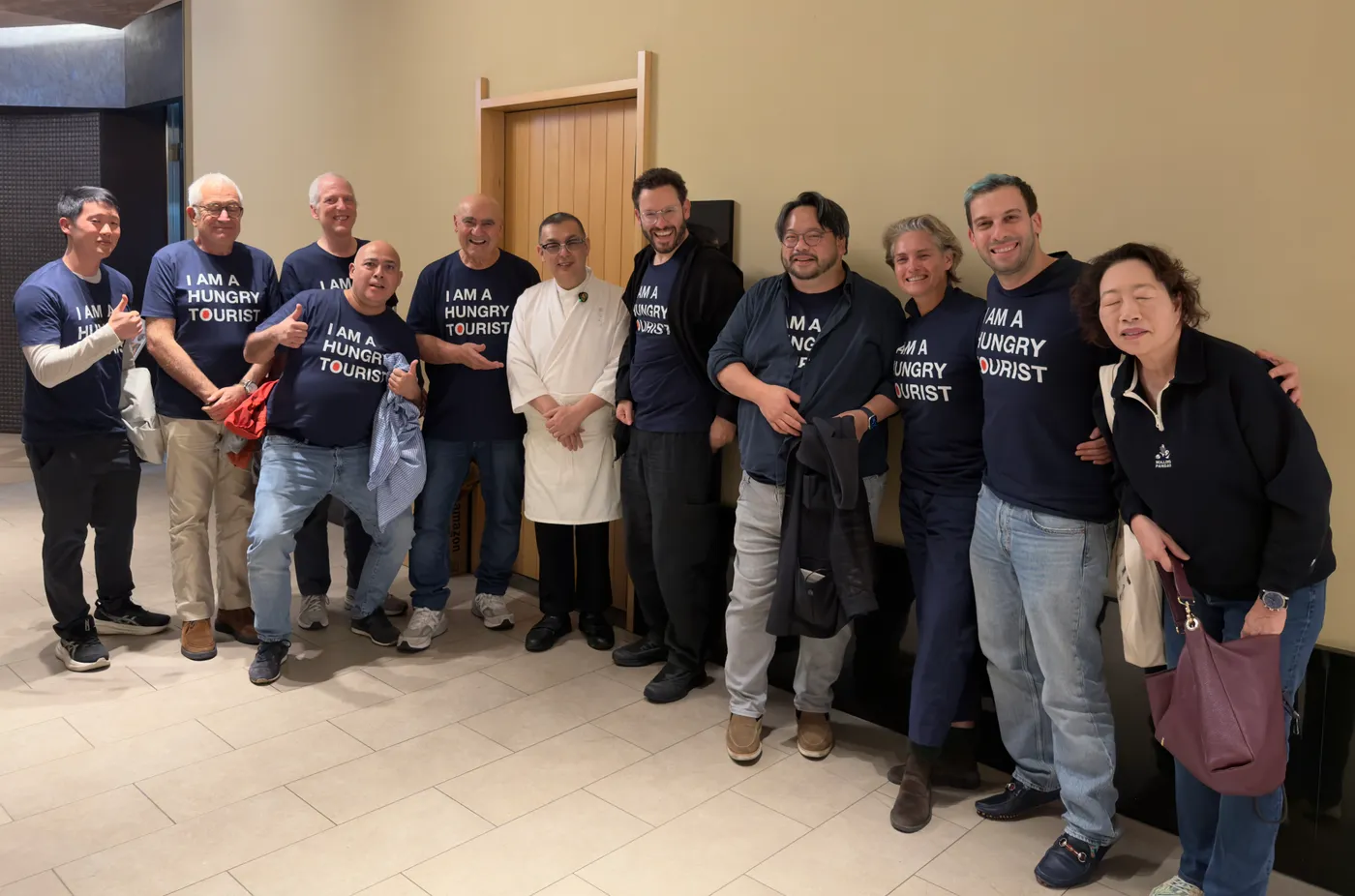
Namba and Hungry Tourists of Best of Tokyo Super Tour, Nov 15, 2026