Confine Pizza
Visited Sun, Nov 8, 2026 · Dinner
Confine, Milan.
Confine
From Salerno to Milan, and Beyond the Boundaries of Pizza
There's something particularly frustrating about missing a dinner you've been looking forward to, especially when you've organized it yourself and the friends who went without you come back telling you how wonderful it was.
That's exactly what happened to me at Confine.
During our White Truffle Road Trip, a last-minute change in our reservation created some serious logistical difficulties. Francesco Capece and his team went out of their way to accommodate my friends, but by the time everything was resolved, it was simply too late for me to join them.
They went, they ate, and they loved it. I missed the whole thing.
But the story doesn't end there.
Afterward, I had a long and thorough conversation with Francesco about Confine, his cooking, the philosophy behind his pizzas, and the dishes he had prepared for my friends. He generously walked me through his ideas in Italian, explaining not just the ingredients and techniques, but the memories, frustrations and moments of inspiration that led him to create them.
And the more I listened, the more fascinated I became.
Because what Francesco and his partner Mario Ventura have created in Milan is much more than an ambitious pizzeria. It's the result of a friendship that began more than twenty years ago, a journey from Salerno to Milan, and a shared determination to explore what happens when the traditions of pizza encounter the techniques, ingredients and imagination of contemporary cooking.
Two Friends from Salerno
Francesco Capece and Mario Ventura met in high school in 2004. Both grew up in Campania, and although their professional lives eventually took different directions, they remained close friends, constantly exchanging ideas about restaurants, food and hospitality.
Francesco began making pizza at nineteen, working in his family's pizzeria and tavola calda. I particularly love the way he describes those early years. He didn't start making pizza because he was following some grand culinary ambition. He started out of necessity, but discovered that what he was doing made people happy, and that gave him a reason to continue.
Over the years, he worked in different pizzerias in Campania and spent time in the United States before opening his own restaurant, La Locanda dei Feudi, in a small village near Salerno. Mario, meanwhile, followed his fascination with wine, Champagne, cocktails and hospitality, developing his own business in Salerno and eventually studying at the Campari Academy in Milan.
The two friends had always imagined doing something together, and in 2018 they began developing a common project. Initially, they planned to open it in Salerno, close to everything and everyone they knew. But during a visit to Milan, they realized that perhaps the time had come to leave their comfort zone.
They decided to take the risk, move north and create something that brought their two worlds together.
The result was Confine.
The restaurant occupies a former hardware store in Milan's historic Cinque Vie district, with an open kitchen, several dining rooms and an underground cellar containing approximately 600 wine labels. Francesco oversees the food, while Mario brings his experience in wine and hospitality. Their different interests are not competing ideas but complementary ones, and together they form the identity of the restaurant.
The name Confine means boundary, and the more I learned about the place, the more appropriate it seemed. For these two friends, the boundary between Salerno and Milan became an opportunity to bring different traditions together. For Francesco, it also became a way of exploring the territory between pizza and contemporary restaurant cooking without losing the character of either.
A Journey from Salerno to Milan
One of the most revealing things Francesco told me concerned a dish he calls Salerno-Milano, which he considers among the clearest expressions of Confine's identity.
The idea begins with two great culinary traditions. From Milan, he takes riso al salto, ossobuco and gremolata. But instead of preparing the ossobuco in the familiar Lombard manner, he cooks it like a Campanian Sunday ragù, with soffritto, tomato and long, slow cooking, then serves it with its marrow and demi-glace.
It's a beautiful way of describing a personal journey through food. The ingredients and preparations belong to different regional traditions, but the resulting dish reflects the experiences of someone who grew up in one place and chose to build his future in another.
Francesco didn't describe this dish as an exercise in fusion for its own sake. What interested him was bringing the cooking of his childhood into conversation with the culinary culture of the city that had become his home.
That distinction became increasingly important as our conversation continued. Although his dishes often contain unexpected combinations, they aren't simply about putting unusual ingredients on pizza. Francesco thinks carefully about the structure of each preparation, the role of the dough, the different textures, and the memories that give an ingredient meaning.
His menu is called Una Terza Dimensione Inaspettata, or An Unexpected Third Dimension, and it's an appropriate name for a collection of dishes designed to challenge our expectations of what a pizzeria can serve.
Francesco works with different doughs, flours, fermentation times and cooking techniques. Some remain close to the Neapolitan tradition, others are fried before being finished in the oven, while still others borrow the structure of brioche or other leavened preparations.
But the most interesting part of our conversation was discovering how each dish began with a particular question.
Sometimes that question came from a traditional preparation he wanted to reinterpret. Sometimes from a memory of home. And sometimes, wonderfully, from something that had always bothered him about the way pizza was served.
What we ate
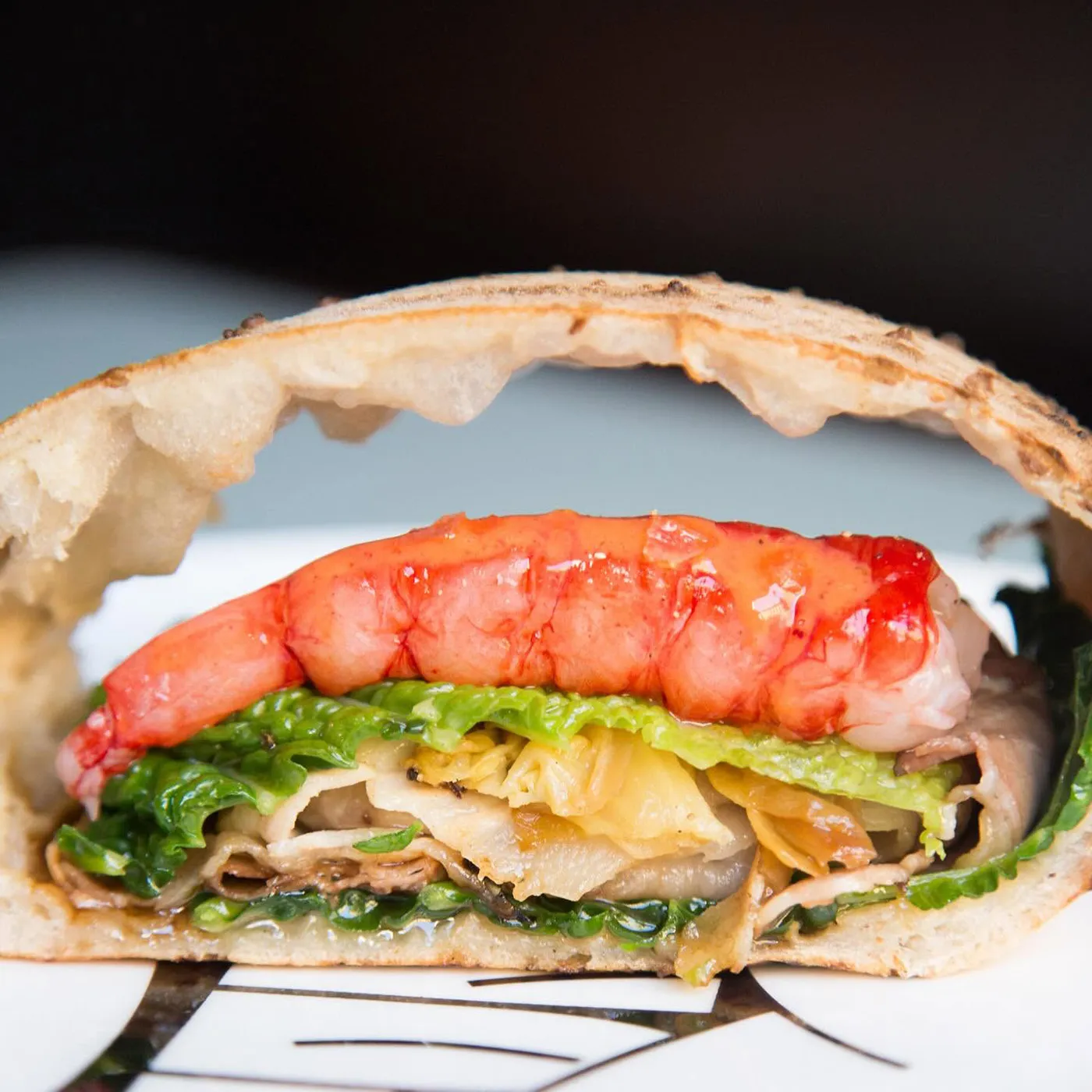
Calgyoza
Giving the Forgotten Calzone a New Life I think the Calgyoza might be the best example of how Francesco's mind works, because its story begins with a problem that most people would never consider important. He told me that the traditional Neapolitan calzone had always been something of an unfortunate outsider on pizzeria menus. Customers often overlooked it, partly because its filling was hidden inside the folded dough. Unlike an open pizza, where you could immediately see the ingredients, the calzone revealed almost nothing about itself until you cut into it. Francesco wanted to change that perception and give the calzone a new identity. His inspiration came from the Japanese gyoza, another preparation built around a filling enclosed in dough. What fascinated him was the contrast between the modest appearance of a closed dumpling and the explosion of flavor waiting inside it. But he also wanted to make the filling visible, giving the dish a more open, playful and theatrical structure. The result is Calgyoza, a Neapolitan calzone reimagined through a Japanese idea. Soy-glazed Savoy cabbage, marinated pork belly, Mediterranean red prawn, black lime and Itrana extra virgin olive oil come together beneath an arch of baked dough that reveals rather than conceals its filling. Looking at the photograph, I can understand exactly what Francesco was trying to achieve. The ingredients become part of the presentation, while the dough still gives the dish its identity. What I particularly enjoy about this story is that Francesco wasn't trying to invent a new kind of pizza simply to be different. He wanted to restore value to an old one that he felt had been neglected.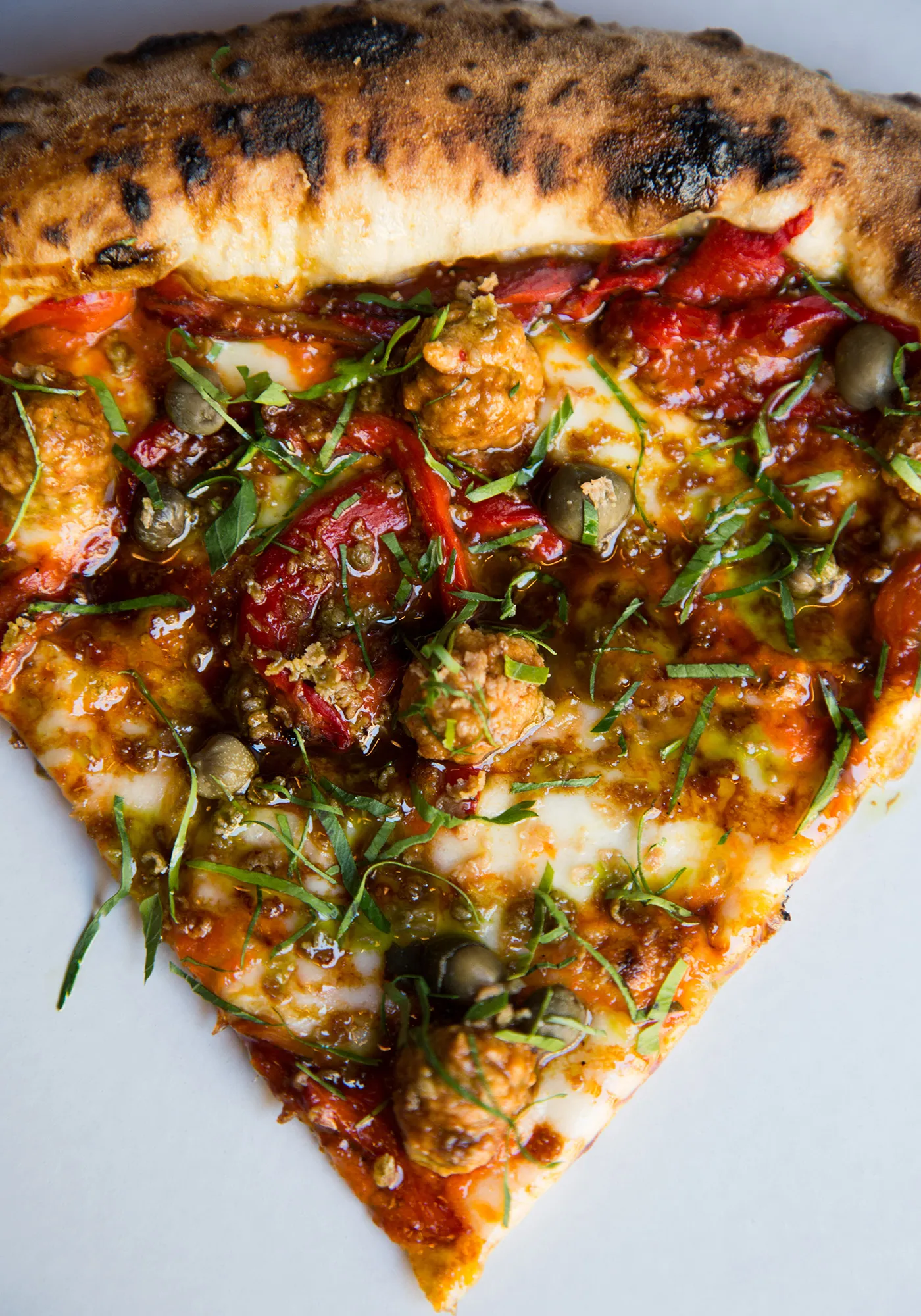
Peperone Tonnato
Piedmont, Naples and the Whole Tuna The second dish takes us from Campania to Piedmont, where vitello tonnato is one of the most familiar traditional preparations. But instead of starting with veal, Francesco begins with the pepper. He explained that the idea was to reinterpret this classic through a vegetable-led preparation, while keeping the foundation unmistakably Neapolitan. The pizza uses traditional Neapolitan dough, with peppers appearing in several different forms: roasted, as a cream and as a reduction. Mint contributes its fresh, balsamic character, while capers bring the Mediterranean flavors that Francesco knows so well. The tuna preparation is particularly interesting. Rather than using only the most familiar cuts, Francesco makes a chopped mixture of tuna and egg using the cheek and collar, seasoning it with powder from sciuscillone di Teggiano, a sweet pepper from Campania. This led us into another part of his philosophy. Francesco explained that when Confine works with an animal or fish, the kitchen tries to use the product as completely as possible, finding appropriate preparations for parts that might otherwise be overlooked. So Peperone Tonnato becomes much more than a playful variation on a Piedmontese classic. It brings together the vegetable traditions of southern Italy, the flavors of Piedmont, a Neapolitan pizza base and Francesco's commitment to making full use of his ingredients. I would have loved to taste how all those elements came together, but at least now I understand what he was trying to express.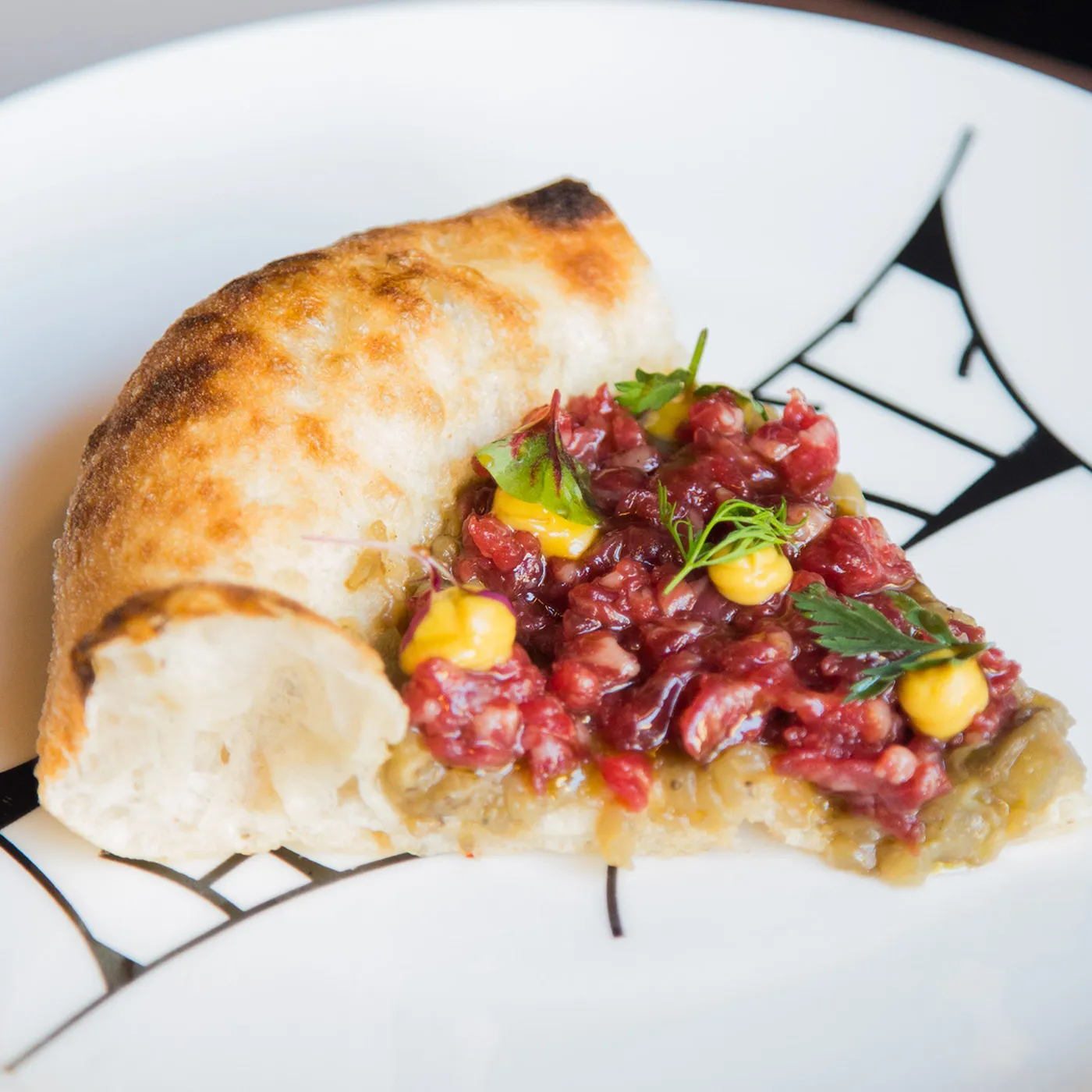
Tiro a Giro
The Unexpected Possibilities of Fried Pizza When Francesco began describing Tiro a Giro, he returned to another very traditional Campanian preparation: fried pizza that is subsequently finished in the oven. Usually, he explained, this technique is associated with familiar toppings such as Margherita or Marinara. He wanted to challenge that expectation by bringing the language of contemporary restaurant cooking to a product deeply rooted in Neapolitan tradition. His version begins with roasted aubergine, prepared to preserve its soft, rich flesh. To this he adds first-cut tartare of Bavarian heifer and a demi-glace made from the meat, creating a contrast between the raw beef and the cooked vegetable. Béarnaise introduces a classic French technique, while mixed greens and toasted hazelnuts contribute freshness and texture. But the hazelnuts are not an incidental detail. Francesco uses Tonda di Giffoni hazelnuts, a product of Campania that he clearly loves. During our conversation, he returned repeatedly to ingredients that connect him to his homeland, and the hazelnut was one of the most important. It's also a way of giving the dish a different kind of richness and a crisp contrast to the softer components. What fascinates me is how many culinary traditions coexist in what is still, fundamentally, fried pizza. Campanian dough, French béarnaise, raw beef, roasted aubergine and hazelnuts from Francesco's home region all become part of the same preparation. This is one of the photographs that made me particularly regret missing the dinner. I can imagine asking Francesco a dozen questions about it while everyone else was trying to eat.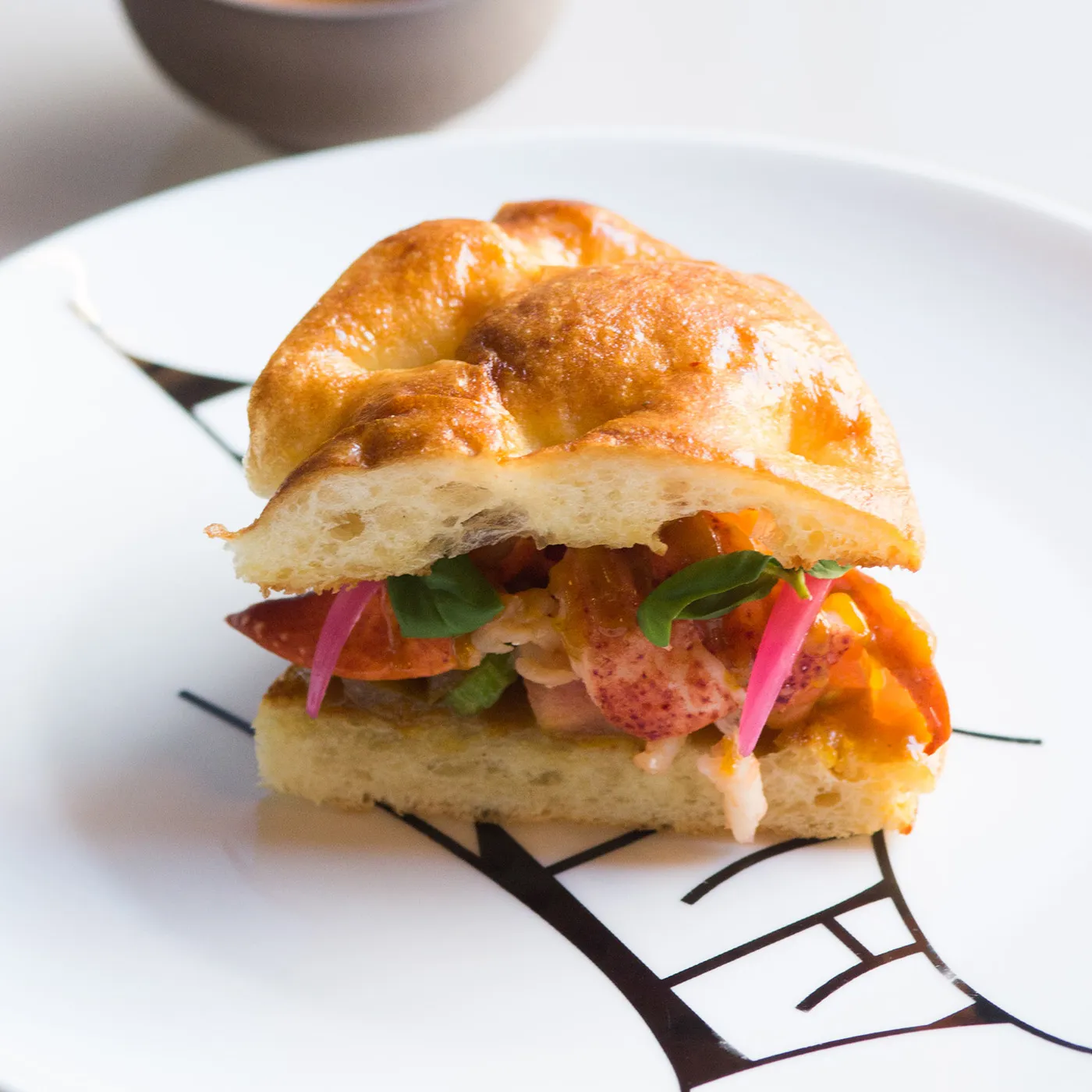
Astice alla Catalana
When Brioche Becomes Pizza Francesco describes Astice alla Catalana as an esercizio di stile, an exercise in style, and admits that the dish contains an element of deliberate provocation. The starting point is the familiar Mediterranean preparation of lobster with vegetables, something recognizable and easy to enjoy. But instead of serving it as a conventional seafood dish, Francesco places it inside a brioche treated and presented as though it were a filled pizza. The dough is toasted with smoked Jersey butter and filled with steamed lobster, Camone tomatoes, marinated Tropea red onion and celery. Spicy tomato ketchup contributes another layer of flavor, while the most surprising element is served alongside: ice cream made from lobster-shell bisque. What I like about the idea is that the lobster remains the center of the preparation. Francesco hasn't abandoned the character of astice alla catalana, but he has changed the way the guest encounters it. The brioche provides a new structure, the filling preserves the familiar ingredients, and the bisque ice cream introduces an unexpected temperature and texture. It's a playful idea, certainly, but one that Francesco has clearly considered in great detail. Hearing him explain it made me wish even more that I had been there to experience the dish myself.